What I Learned at COP30 in Belém: Local Government, Climate Justice, and Career Lessons
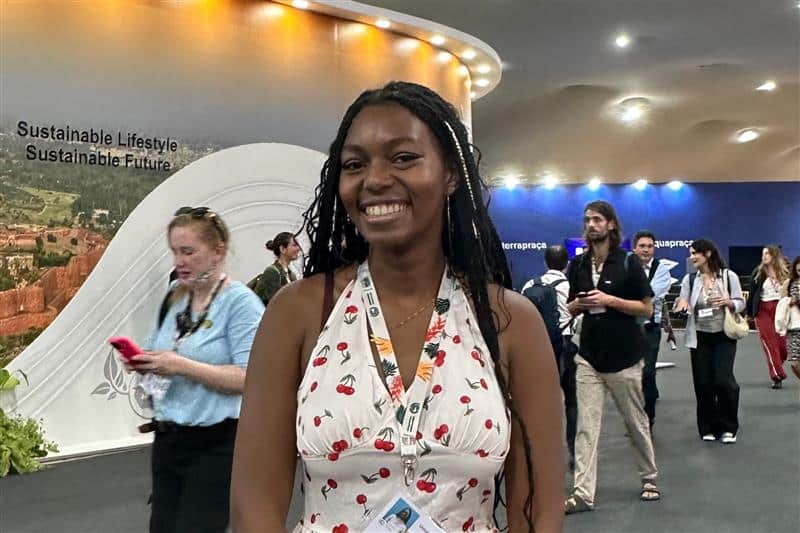
This past November, current student Brianna Beadle, Public Administration and City and Regional Planning ’26, had the opportunity to attend the 30th United Nations’ Climate Change Conference (COP30) held in Belém, Brazil. The COP is attended by all countries that have signed and ratified the United Nations Framework Convention on Climate Change (UNFCCC). Currently, 198 countries participate, making it one of the largest multilateral bodies in the United Nations (UN) system. We connected with Brianna to learn more about the conference and how she plans to apply what she learned in her future.
Q1: Brianna, you received an invitation to represent UNC at the premier global conference for climate change COP30 held by the United Nations. Can you tell us about how this opportunity came about?
I learned of the opportunity to attend COP30 in Belém through an email from Dr. Todd BenDor from the City/Regional Planning Department. Each year, UNC sends a few students to the United Nations Conference of the Parties (COP), and this year marked the 30th COP. I decided to apply. This opportunity resonated with me, especially given my interest in climate justice and resiliency. Last year, I conducted my applied research project on how local governments could improve the climate resiliency of vulnerable populations. I submitted my application without expecting much, assuming I wouldn’t be selected. However, I need to have more faith in myself as I was chosen to attend. I am one of four students and two alternates selected.
Q2: Where did your interests in public service leadership and environmental protection come from?
My interest in climate resilience and public service really developed during my undergraduate years, especially throughout the pandemic. With everything online, it became much easier to get involved with community organizations and do grassroots work without leaving my house. The first time I truly thought about environmental protection and its impact on all of us was in elementary school. I’m originally from South Florida, home to the Everglades. I lived so close that when the Everglades were on fire, you could see the red sky and smell the smoke during school hours. I remember in fourth grade, our teacher showed us a photo of the Everglades from 50 years ago, compared to how it looks now. The habitat had been drastically destroyed. It was the first time I understood so clearly how important it was. The loss of the Everglades means the disappearance of wildlife, clean water, and clean air, but what stood out to me most was the loss of a way of life and how it would impact people, especially indigenous communities who depended on the Everglades. While I hadn’t yet learned the phrase “climate justice,” this was the first moment I realized there are real people behind our worsening climate issues.
Q3: You were invited to represent local governments and how their work can contribute to improving climate change. What did you discover?
Being a student from the United States at COP30 was an interesting experience. There were many discussions about the US’s current stance on climate change, and it was noted that, for the first time in the conference’s 30-year history, the US did not send an official federal delegation. However, this opened up many conversations about how the US could still be an active participant in fighting the climate crisis, not just at the federal level. COP30 was called the “implementation COP,” and a speaker at a side event at the “Cities and Regions Hub” pavilion mentioned that implementation is impossible without local governments. To me, this seems obvious and essential for driving any kind of transition. Still, it was a message repeated often, and I believe it was central to every side event I attended related to local governments. While I am speaking from a US perspective, I feel most panelists, regardless of their country, echoed this sentiment.
Q4: Was there a meaningful seminar, connection, or priority you want to share with us?
For me personally, it was the many conversations I had. My favorite connections didn’t come from speaking with panelists after events or from traditional networking. Instead, they occurred during friendly interactions or random conversations with others on buses back to our lodgings or between sessions. One of my favorite interactions was on the bus ride home on my second day of COP. The bus was crowded, and many people were standing because there were no seats left. A man struck up a conversation with me and asked about my story. I told him the basics: I’m a Master of Public Administration and City/Regional Planning student at UNC Chapel Hill, interested in climate justice, and originally from Florida. Little did I know, I was talking to the Chief Sustainability Officer of Maui, Hawaii, who has incredible experiences and stories to tell. Honestly, I was pretty afraid during my first few days that, at such an international conference, I wouldn’t be able to connect with people on a local level, especially since I’m from the U.S. But by chance, I found myself talking to a local government official from an area in the U.S. that’s on the front lines of the climate crisis, just like I was. His career path was inspiring, and the stories he shared in our short chat were mind-blowing. That was just one of dozens of connections I made and plan to follow up on.
Q5: What has been a skill you have developed while enrolled in the MPA program that has contributed to your growth as a leader?
The most notable skill I have developed has definitely been my confidence in speaking and building connections. My entire life, I have had a stutter, and I’ve always felt like it has held me back in professional social settings. However, my last three years in the MPA program have strengthened my confidence in public speaking and my ability to approach people, strike up conversations, and build connections. This skill was definitely of the utmost importance and was incredibly useful for a conference like COP30. Without the speaking opportunities I have had in the MPA program, I do not believe I would’ve been able to flourish at COP30 as much as I did.
Q6: And a fun question to end with. What are you excited about upon graduation?
As of now, I am still exploring career options for graduation, but I am excited about securing a full-time role soon that allows me to work on projects that benefit marginalized communities. Growing up in South Florida, I have always been around large Spanish-speaking communities. To enhance my skills for my future career, I am taking Spanish lessons and aim to become fluent by the end of the year. Hopefully, this will help me improve my communication skills and reach more people than I can with just one language.