Lessons in Leadership and Collaboration: ACCESS the Arts at Lazy Daze Arts & Crafts Festival
Written by Megan Lanning
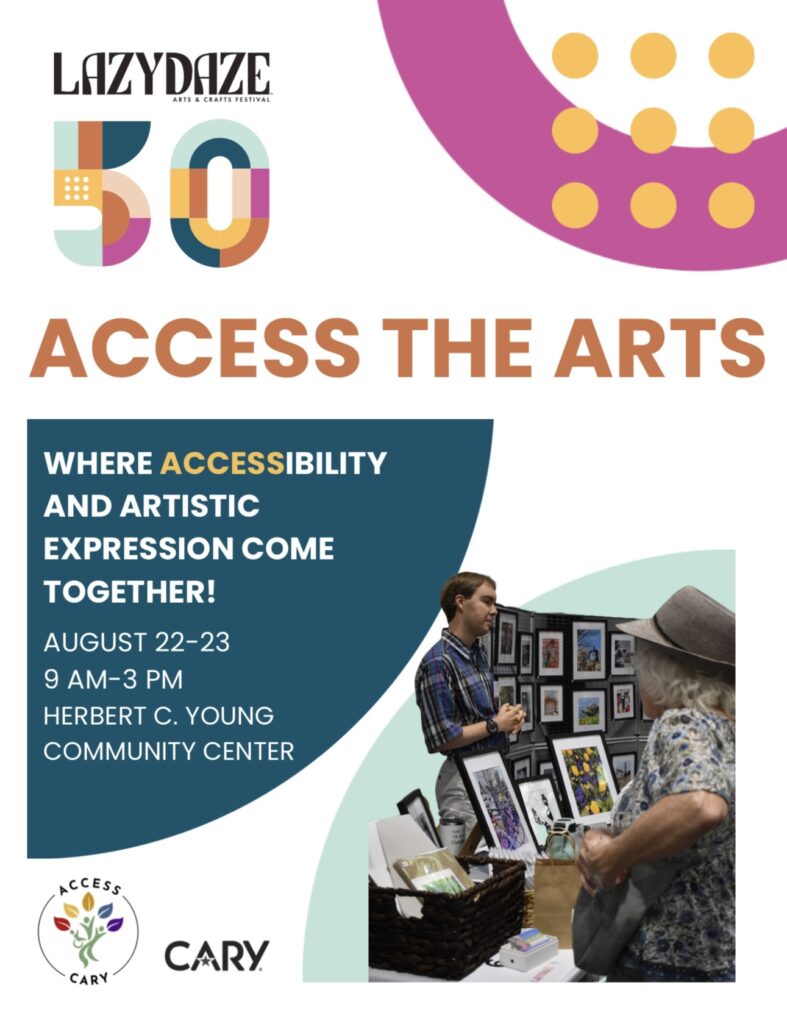
One of the most meaningful experiences I have had during my time with ACCESS Cary has been serving as the ACCESS the Arts Coordinator and helping lead the collaboration between ACCESS Cary and the Lazy Daze Arts & Crafts Festival. Lazy Daze is a major Cary tradition that brings hundreds of artists and thousands of community members together each year, and this year marks the 50th anniversary. We are continuing an initiative we started last year within the festival called ACCESS the Arts, an indoor artist market highlighting the creativity, talent, and artistic expression of North Carolina artists with disabilities. The market will feature 9 artists, giving them an opportunity to share and sell their work while connecting with the community.
Being part of this collaboration has given me a much better understanding of what leadership looks like when you are working across teams and departments. ACCESS Cary and the Lazy Daze team each brought different knowledge and priorities to the project. Lazy Daze has years of experience planning and running a large-scale festival, while ACCESS Cary brings expertise in inclusion, accessibility, and supporting individuals with disabilities. The success of ACCESS the Arts has depended on bringing those perspectives together rather than having one team do everything on its own.
One of the biggest lessons I have learned is that successful collaboration starts with communication. There are so many details that go into an event like Lazy Daze that it would have been easy for accessibility to become just one item on a long checklist. Instead, our collaboration has made accessibility part of the conversation from the beginning. We have had to think about everything from the location of the artist market and how artists will participate in how attendees with different needs will experience the festival. The goal is not simply to make accommodations when someone asks for them, but to intentionally create an environment where more people can participate from the start.
This has also been an opportunity to see accessibility on a much larger scale than I have in some of my other work with ACCESS Cary. The festival already provides a variety of accessibility resources, including accessible parking and shuttles, wheelchair loans, accessible restrooms, large-print materials, quiet hours, and ASL interpretation by request. This year, there are also additional sensory-friendly resources, including a Zen Den. The Zen Den provides a more sensory-friendly space where guests can step away from the activity of the festival, use sensory tools, and recharge before returning when they are ready.
The sensory resources are especially meaningful because they demonstrate that accessibility can look different for different people. Sometimes inclusion means creating an accessible physical route or providing a wheelchair. Other times, it means having a quieter space, noise-reducing headphones, flexible seating, or sensory tools available. ACCESS Cary’s sensory resources recognize that participants can use these supports for sensory support, a quieter space, or simply time to recharge during their recreation experience. As we continue developing these resources for Lazy Daze and other community events, I have seen how important it is to listen to the people who will actually use them.
My role as the ACCESS the Arts Coordinator has also challenged me to think about leadership differently. I have learned that being a leader does not mean having all the answers or making every decision. A large part of leadership is ensuring the right people are included in the conversation, communicating clearly, following through, and helping move a shared idea forward. There have been plenty of moving pieces throughout this process, and collaboration has required flexibility as plans change or new ideas come up. I have learned that being willing to listen and adjust can be just as important as having a plan.
This experience has connected closely to what I have learned in my MPA coursework about collaboration and public administration. Local government is rarely able to solve a problem through the work of a single person or even a single department. Creating an inclusive community requires different areas of expertise to work together toward a common goal. ACCESS the Arts is a relatively small part of a much larger festival, but it has shown me how collaboration can turn an idea into something that directly affects the community.
Most importantly, this experience has reinforced the type of leader I want to become. I want to be someone who listens to different perspectives, communicates clearly, and looks for opportunities to bring people together. I also want to continue approaching accessibility proactively rather than treating it as an afterthought. My work with ACCESS Cary has shown me that some of the most meaningful changes occur when people from different backgrounds and areas of expertise are willing to work together toward the same goal.
As I continue my MPA journey and think about my future career, I know collaboration will be a major part of the work I want to do. Whether I continue working in disability advocacy, accessibility, local government, or the nonprofit sector, I will need to work with people who have different experiences and perspectives than my own. Leading the collaboration for ACCESS the Arts has given me the opportunity to practice those skills in a real-world setting. More than anything, it has shown me that effective leadership is not about doing the work alone. It is about creating relationships and communication needed to make meaningful changes happen together.
Visit ACCESS the Arts at Lazy Daze on August 22nd-23rd from 9 a.m.-3 p.m. in the Herbert C. Young Community Center (Section C of the festival). For more information on Lazy Daze and ACCESS the Arts, visit the Cary, NC website.