Making Relationship Work More Visible
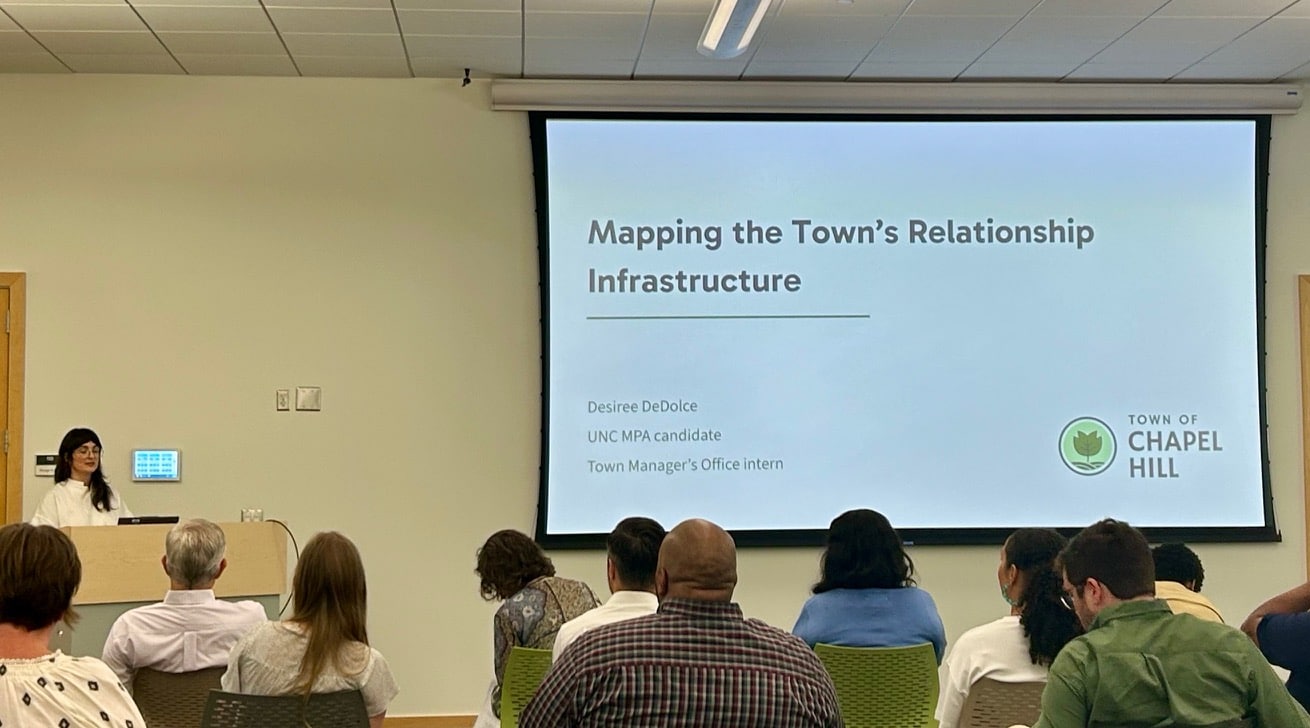
This post is written by current student Desiree DeDolce.
Desiree DeDolce is from Winston-Salem, NC. She earned her undergraduate degree in Sociology from UNC Greensboro and has a passion for housing justice, with a particular interest in resident-centered, community-based housing models for low-income families. This summer, she is completing her Professional Work Experience with the Town of Chapel Hill Manager’s Office.
———————————————————————————————————-
One of my primary projects during my PWE was creating a relationship map of the Town of Chapel Hill’s connections with external organizations. The idea grew out of something I noticed early in my internship: much of the Town’s work depends on coordination with outside partners, including other municipalities, Orange County, UNC, nonprofits & community organizations, state agencies, etc. Some of these relationships are formalized through agreements or established processes and tend to be more visible at an organizational level. Others are more informal, relying heavily on individual staff relationships, informal communication, and years of accumulated knowledge. These relationships are often part of a less visible organizational infrastructure, but they can be just as important to the Town’s day-to-day work.
Over the course of the summer, I interviewed department directors and key staff from across the organization about their roles, the partners they work with, and how those relationships function in practice. I initially expected the project to focus primarily on identifying and mapping those connections. As the interviews continued, though, some broader themes began to emerge about the work required to build and maintain them.
Several staff members talked about relationship management as work that can be largely invisible. Maintaining a partnership often requires ongoing communication, follow-up, trust-building, and informal coordination that may not appear in a formal agreement or job description. Staff also raised concerns about what happens when those relationships are held primarily by one person. When someone leaves the organization or a project ends, an important connection or piece of institutional knowledge can easily disappear with them.
The interviews also challenged the common conception that the Town has monolithic relationships with major partners. UNC and Orange County were the clearest examples. It is easy to talk about “the Town’s relationship with UNC” or “the Town’s relationship with the County” as though each is a single, one-dimensional connection, but staff described many different kinds of relationships across departments, offices, programs, and individual staff members. Those relationships vary widely in purpose and formality and are often maintained independently by people throughout the Town organization. More broadly, the interviews showed that relationships with external partners are rarely entirely collaborative or wholly challenging. The Town may be working closely with a partner in one area while navigating different priorities, constraints, or disagreements in another.
My role was to bring those individual perspectives together. I documented the relationships staff identified, looked for patterns across interviews, and developed a visual map and presentation that showed both the Town’s network of external partners and some of the less visible work behind those connections. The goal was not to create an exhaustive inventory, but to provide a broader picture of how relationship-based the Town’s work is and where some vulnerabilities may exist.
The most tangible contribution of the project was giving staff a way to see and talk about something they were already experiencing but did not necessarily have a shared framework for describing. The final presentation highlighted the amount of invisible labor involved in maintaining relationships, the risk of losing informal connections and institutional knowledge through turnover, and the importance of recognizing that relationships with major partners are made up of many smaller relationships across the organization. My recommendations focused on making important relationships more visible internally, building some continuity around them, and recognizing relationship maintenance as part of the Town’s organizational capacity.
The project did not solve relationship challenges, but it helped make them more visible and gave staff a shared way to talk about them. By bringing together knowledge that was otherwise spread across departments and individual staff members, the project created a clearer picture of the relationships that support the Town’s work and where more continuity or attention may be needed.