How One Conversation Sparked Opportunity for Noah Ellington
By Hattie Lecka
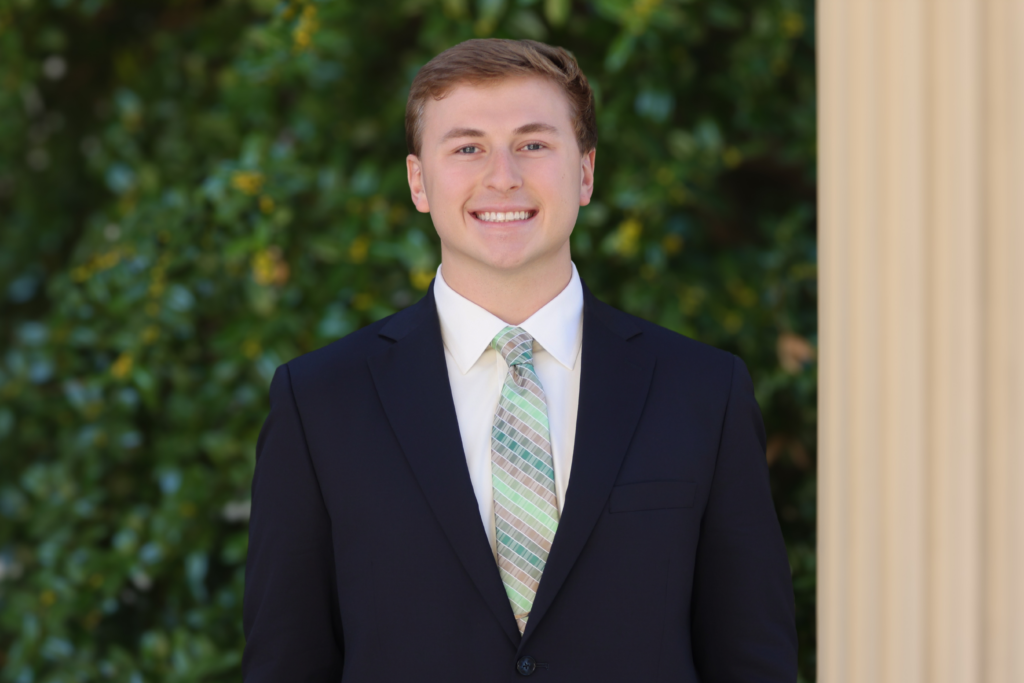
When MPA student Noah Ellington attended an alumni event in January, he did not expect a casual conversation could lead to a remarkable professional opportunity. Ellington, a graduate researcher for the North Carolina Benchmarking project, has been seizing every opportunity to network as he prepares for graduation. On that day in January, a chance encounter led him to collaborate closely with congressional staff and gain firsthand experience in public service at the national level. What began as a simple discussion quickly evolved into a behind-the-scenes role in planning a high-profile retreat for congressional chiefs of staff, giving Ellington a unique perspective on the inner workings of national government.
On March 13, the School of Government welcomed a group of congressional chiefs of staff to UNC for a three-day retreat. While the School of Government is widely recognized for its work with local and state officials, engagement at the federal level is less common. Last year, the Chancellor asked the dean if the School could host a retreat for congressional chiefs of staff, collaborating closely with the Congressional Management Foundation (CMF), a nonprofit organization that works to improve communication and management within congressional offices.
Ellington, who had no prior plans to be involved, found himself coordinating and attending the retreat, which was an unexpected opportunity that allowed him to step into a new realm of public service work.
- Can you tell us how you first heard about this event and became involved in the planning process?
My involvement began with a conversation at the MPA Happy Hour following the North Carolina City/County Management Conference in January. I had the opportunity to speak more in depth with Dean Wall, whom I had seen around the School and briefly interacted with before, but hadn’t yet connected with one-on-one.
During our conversation, she mentioned the upcoming Chiefs of Staff retreat and noted that, as a new program, there were still several logistical pieces to work through. I offered to help, and she encouraged me to follow up.
I was glad to do so, and from there I began attending planning meetings and supporting the team. Before long, I was helping to develop the agenda, coordinate the campus tour, and assist with other logistical details for the retreat.
- What connections did you notice between the retreat sessions and the concepts you’ve studied in the MPA program?
I’ve taken classes with many of the faculty who led sessions, including Dr. Jacobson, Dr. Pasha, and Dr. Morse, so it was especially interesting to see those ideas applied in a different, practitioner-focused context.
I was particularly struck by how the chiefs engaged with the material in ways that mirrored discussions I’ve seen among my classmates. The faculty were also very intentional in how they facilitated each session, adapting to the energy in the room and creating space for honest and sometimes vulnerable conversations.
I also noticed how thoughtfully the retreat was structured. Each session built on the previous one, allowing participants to carry ideas forward rather than treating each topic in isolation.
- Your journey began with a single conversation at an alumni event. What advice would you give MPA students about saying ‘yes’ to unexpected opportunities?
I think a big takeaway is to be open to opportunities, even when they feel small or uncertain at the time. This experience came from a single conversation that I almost didn’t stay for. Even though I was exhausted from spending the day at the conference, I decided to stay a little longer and attend the happy hour, which ended up making all the difference.
Saying yes does not mean overcommitting, but it does mean being willing to show up, follow up, and express interest. You never know which conversation might lead to something meaningful.
- What was it like working behind the scenes to plan the retreat, and what lessons did you learn about leadership, teamwork, or public service?
This experience reinforced how important it is to be flexible and aware of your surroundings. Plans change quickly, and being able to adapt without losing focus is critical.
I also learned the importance of taking ownership of mistakes, no matter how small. Everyone makes them, but how you respond matters. Acknowledging them and moving forward builds trust, while avoiding them can have the opposite effect.
Finally, I saw how important it is to read the room and understand where you can be most helpful. That awareness allows you to contribute effectively without overstepping.
- Looking back, what was the most rewarding or eye-opening part of this experience? How has it shaped the way you think about your role as a future public service leader?
One of the most rewarding parts of this experience was building relationships with School of Government faculty and staff, whose work I deeply respect. It was also valuable to interact with such an influential group of public service leaders.
I also found the experience eye-opening in terms of how Congress operates. Public perception often focuses on dysfunction, but this retreat highlighted the amount of relationship-building and intentional management that happens behind the scenes. It made the work feel more human and more relatable.
- How has this experience shaped your career vision, and what do you hope other MPA students take away from your story?
This experience showed me that strong management and leadership skills are needed across all levels of government. Because of that, I can now see myself working at the federal level, whereas before I was primarily focused on local government.
It also helped me see that, despite how intimidating federal institutions can seem, the people working within them are approachable and willing to share their experiences. That made the path feel more accessible and confirmed my interest in continuing to explore opportunities in that space.
- What advice would you give MPA students about networking, taking initiative, or stepping outside their comfort zone?
My biggest piece of advice is to take advantage of opportunities to connect, even when it feels inconvenient or outside your comfort zone. Stepping outside your comfort zone is a skill that improves with practice. The more you do it, the easier it becomes.
It is also important to approach conversations with curiosity. Focus on understanding the other person’s perspective and experiences. That not only makes the interaction more meaningful, but also helps you build relationships that last beyond a single conversation.