This post is written by current student Tyler Holden.
Tyler Holden is a current student in the online format. Originally from Winston-Salem, North Carolina, Holden completed his undergraduate degree in Political Science from UNC Greensboro. As a former Americorps Lead for North Carolina Fellow, he is pursuing his interests in local government and is currently employed with the Town of Hillsborough and completing his Professional Work Experience with the Hillsborough Police Department.
————————————————————————————————————–
Every year, the North Carolina League of Municipalities hosts a dynamic driver training program designed to sharpen the decision-making and driving skills of police officers across the state. Known as the “Slower is Faster” Driver Training, this hands-on experience, led by instructors skilled in the art of autocross, emphasizes precision, awareness, and thoughtful response under pressure — vital qualities for any first responder.
During the first week of my internship with the Hillsborough Police Department, I had the extraordinary opportunity to participate in this training event, held at the Winston-Salem Fairgrounds. As someone aspiring to a career in public service, this experience proved to be far more than a driving exercise — it offered deep, transferable lessons in leadership, strategy, and decision-making in government.
As part of the event, my group organized a portion of the driving course. Using road signs, inflatable deer, traffic cones, and even a remote-controlled car topped with a stuffed dog (meant to simulate a pet darting into traffic), we created a series of unpredictable obstacles. We regularly changed their positions to simulate real-world driving scenarios that officers might encounter on duty.
The objective wasn’t speed, but rather disciplined decision-making. It was about teaching officers how to remain composed, think critically, and respond appropriately in high-pressure situations.
As I observed dozens of officers navigating the course, I began noticing distinct trends. Those who accelerated too quickly on the straightaways often misjudged tight turns, leading to close calls or collisions with cones. In contrast, officers who paced themselves, slowing down strategically to assess and adapt to the layout ahead completed the course more efficiently and with greater accuracy. Just as the name of the training entails, slower really was faster. A classic case of the tortoise and the hare.
The takeaway? Rushing ahead without gauging what lies down the road often leads to errors or setbacks. But those who take the time to evaluate the landscape, anticipate obstacles, and adjust their approach accordingly tend to reach their goals more effectively.
It’s a lesson that extends far beyond the driver’s seat.
The principles behind “Slower is Faster” apply directly to leadership in local government. Just like navigating a challenging driving course, managing a municipality requires anticipating long-term needs, understanding the terrain ahead, and making deliberate, informed decisions.
Whether you’re crafting policy, managing public budgets, or planning community development, effective leadership is not always about rapid responses. It’s about thoughtful planning, steady execution, and knowing when to pause, reassess, and adapt — especially when the stakes are high.
Perhaps the most exciting moment of the training came when I had the chance to ride along with a Hillsborough Police Department officer through the full course. As we weaved through a simulated pursuit scenario complete with autocross instructors playing suspects in other vehicles, I experienced firsthand the mental and physical demands officers face when responding to emergencies.
The adrenaline, the focus, the constant decision-making — it all underscored the importance of preparation and training. It also reinforced the broader lesson: calm, measured responses are often the most effective, even in fast-paced or high-stakes environments.
Participating in the “Slower is Faster” Driver Training is a key highlight of my internship experience. It offered me not only a behind-the-scenes look at how law enforcement officers hone their skills, but also an enduring perspective on leadership, both in public safety and in public service.
As I look forward to a career in local government, I’ll carry with me the lesson that taking the time to observe, think, and plan is the best way to lead with purpose, precision, and impact.
This post was written by 2nd year student Ryan Ledbetter.
————————————————————————————————————–
My name is Ryan Ledbetter, and I am a Master of Public Administration (MPA) student at the UNC School of Government. I’m originally from Harrisburg, North Carolina, a town just outside Charlotte and right next to the Charlotte Motor Speedway. I have always been interested in government, although I didn’t initially plan to pursue an MPA. After graduating from NC State University with degrees in political science and history, I took a job in project management at a technology company. While the role offered valuable experience, it didn’t align with my interests or feel particularly fulfilling. Luckily, a few months into that position I came across a fellowship hosted by the UNC School of Government called LEAD for NC. The LEAD for NC fellowship places recent college graduates in local governments across the state to strengthen public institutions and help develop the next generation of public service leaders. I was placed with the Town of Spencer, just outside of Salisbury, where I worked on several meaningful projects, including designing and administering a school safety and support grant program, developing town policies, and gaining hands-on experience in local government operations. This was a great experience and it played a key role in shaping my decision to pursue a career in public service at the local level.
That experience ultimately led me to pursue my MPA at UNC, especially given that the School of Government is one of the top programs in the country for local government administration. I hope to use this degree to build a career in local government, with the goal of eventually serving in a city or county management role. An integral part of the UNC MPA program is the Professional Work Experience (PWE), which takes place between the first and second year. For my PWE, I am interning with the Stanly County Economic Development Commission (EDC). The EDC is responsible for promoting economic growth and job creation throughout Stanly County. It works to attract new businesses, support the expansion of existing industries, and enhance the county’s overall business climate. Through partnerships with local governments, educational institutions, and private industry, the EDC provides support for site selection, workforce development, and access to both local and state incentives.
As part of my internship, I will be developing a master list of the properties the EDC markets for economic development and working with county businesses and municipalities to create a recommended social media content plan for the next year as part of a broader marketing campaign. In addition to my work with the EDC, I will also get the chance to observe the budget process by shadowing the county manager and commissioners through attending budget workshop meetings. This opportunity is especially exciting because it allows me to gain experience in county-level administration while exploring the field of economic development for the first time.
Lilly Parker is a 2nd year student in the MPA program. As a former teacher from Kentucky, Lilly’s interests are centered around education, advocacy, and child and family welfare. She earned a BA degree in Education from Wake Forest University in 2021.
————————————————————————————————————–
From the Classroom to the Foundation: Launching My Summer with NCCCF
This summer, I’m thrilled to be serving as an advancement intern with the North Carolina Community Colleges Foundation (NCCCF) as part of my Professional Work Experience (PWE) in the UNC MPA program. The opportunity to work directly with the Foundation’s Executive Director, Katie Loovis, who also happened to be my professor for nonprofit management last semester, has been especially rewarding. Learning from her both in the classroom and now in a professional setting has provided a powerful bridge between theory and practice, and I’m excited to continue deepening my understanding of nonprofit management and advancement.
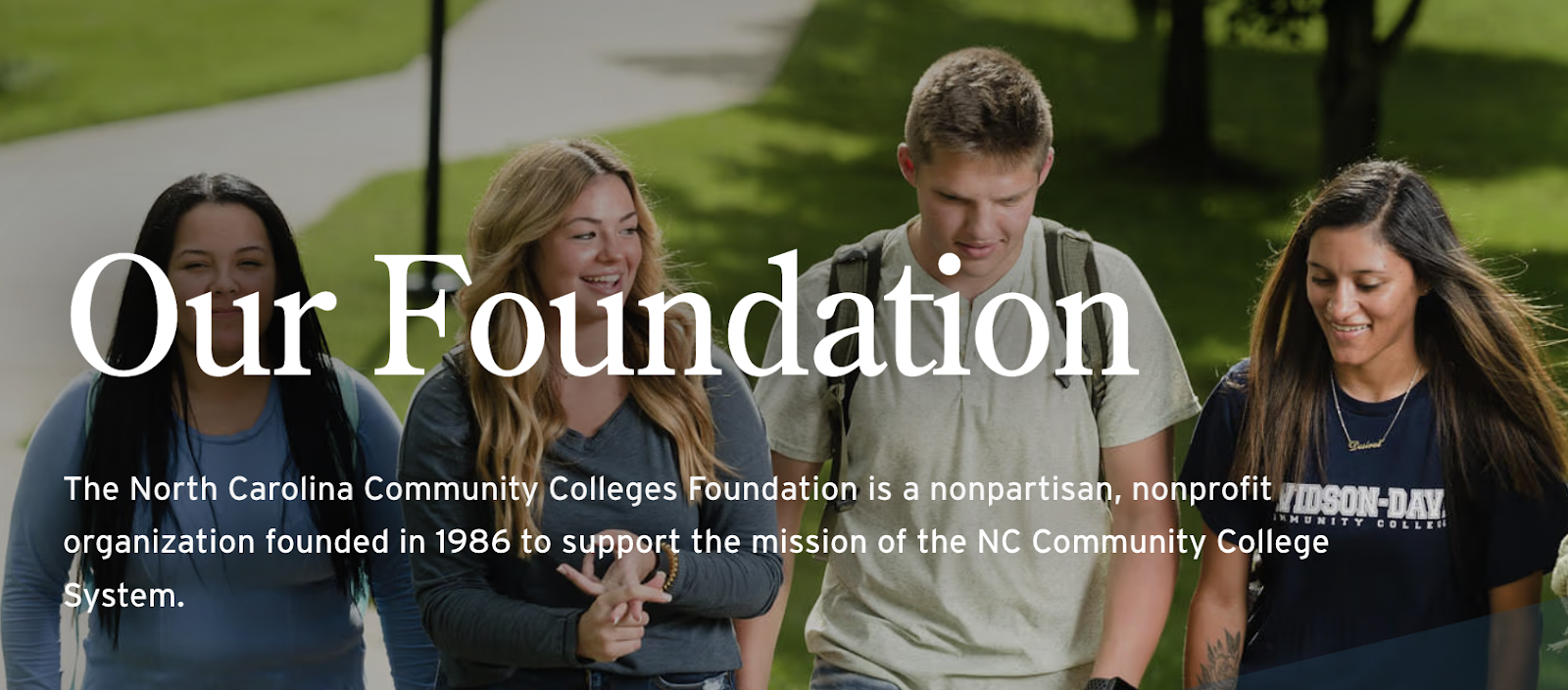
Although my PWE has only just begun, I’ve already been trusted with meaningful projects that align with my interests and push me to grow professionally. I participate in weekly fundraising strategy meetings where the team maps out how to engage funders, shape program pitches, and prepare for meetings with stakeholders. I also have regular one-on-one check-ins with both the executive director and the chief advancement officer to share updates, receive feedback, and discuss how I can continue to contribute to the Foundation’s mission.
My current responsibilities include drafting a gift acceptance policy and a gift agreement for NCCCF, as well as managing the application process for solicitation licenses in new fundraising states. The centerpiece of my summer, however, is a research project focused on nonprofit earned income strategies. I am conducting a literature review on best practices, analyzing IRS Form 990s to understand how peer foundations generate earned income, and interviewing executive directors of other community college foundations to learn from their insights. The final deliverable will be a set of strategic recommendations I’ll present to the NCCCF Board of Directors. I was able to pitch my research proposal during my first week on the job, and I’m proud to say it was met with enthusiasm.
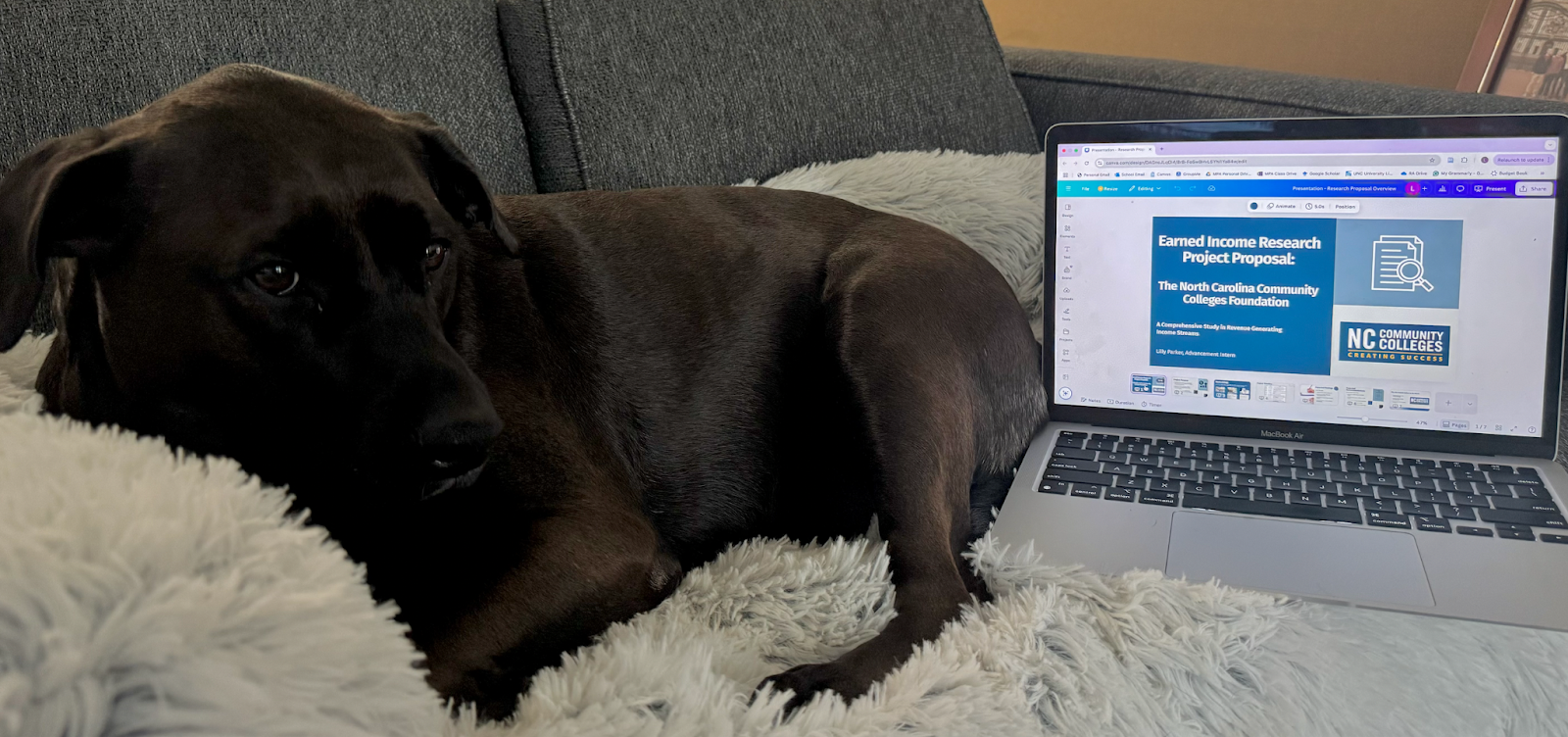
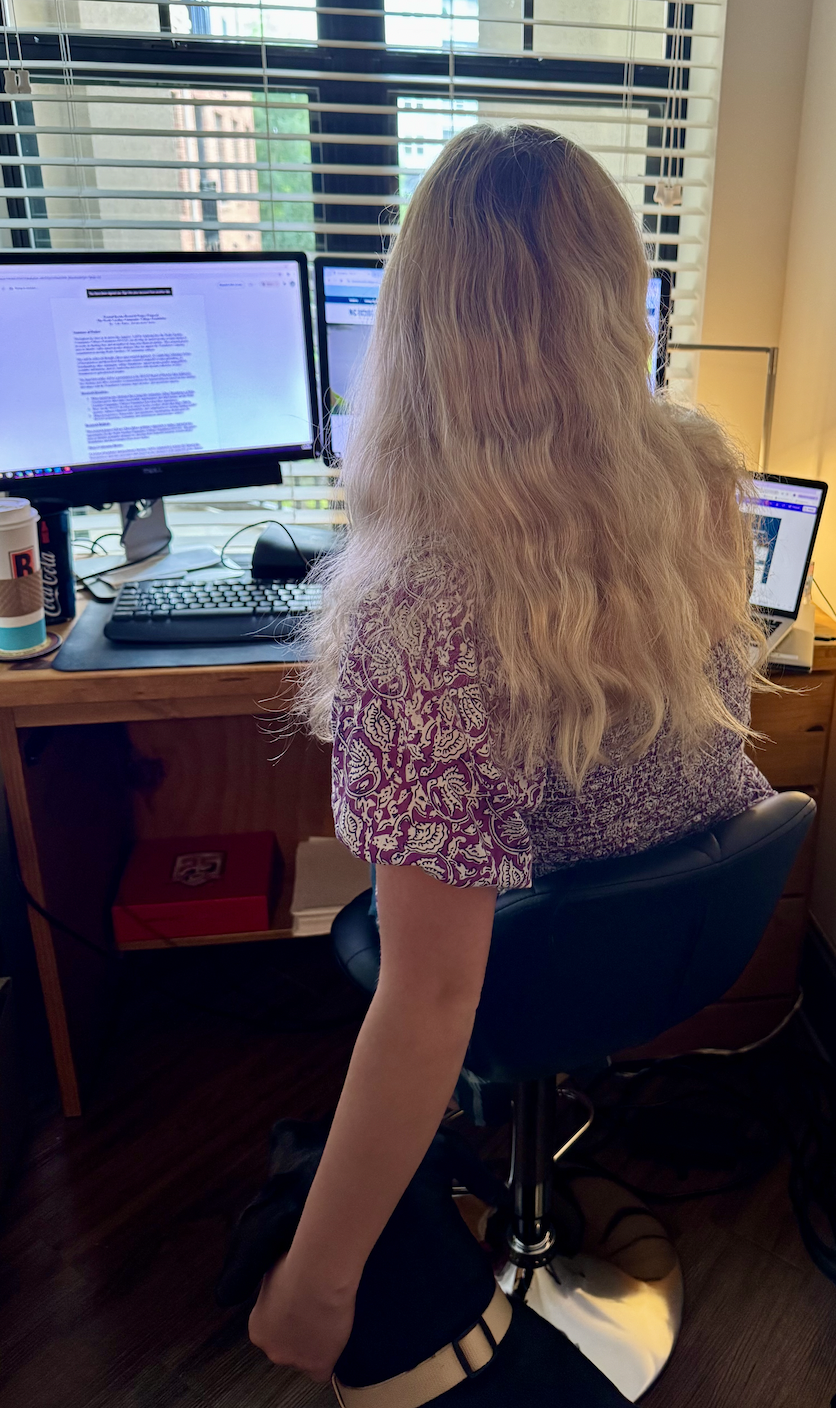
As a former teacher and current MPA student with an interest in nonprofit management and development, this experience is helping me imagine what a future career in development/advancement could look like. I feel incredibly fortunate to be working for an organization that is committed to making higher education more accessible across North Carolina, while also sharpening my skills in fundraising, research, policy writing, and professional communication. Plus, since I’m working remotely, I get to do it all with my sweet dog, Athena, by my side (see pictures)! I can’t wait to see how the rest of the summer unfolds!
This post was written by current student Ushni Gupta.
As the Southern California wildfires continue to rage with devastating consequences, the need for strong leadership at the local level has never been more apparent. California wildfires are no longer seasonal crises—they are a year-round threat exacerbated by climate change and the expansion of development into fire-prone areas. At the forefront of combating these disasters are local community leaders, from city officials to fire chiefs, whose leadership is essential to safeguarding lives, protecting property, and fostering resilience in the face of growing wildfire threats.
Fostering community is critical to minimizing loss of life and ensuring that the infrastructure needed to protect residents is in place. Local leaders play a pivotal role in guiding their communities through all stages of wildfire response. During active fires, they coordinate evacuation efforts, establish shelters, and communicate crucial safety information. After the fires are extinguished, they lead recovery initiatives, helping communities rebuild while prioritizing resilience through investments in fire-resistant infrastructure, vegetation management, and long-term planning to mitigate future risks.
Preparing leaders to navigate these challenges requires specialized training and knowledge, which programs like the Master of Public Administration at UNC-Chapel Hill provide. The UNC MPA program focuses on equipping future public service professionals with the skills needed to address complex crises like wildfires. With coursework in strategic communication, emergency management, public policy, and intergovernmental collaboration, the program develops leaders who can think critically, act decisively, and inspire communities during times of crisis.
As the frequency and intensity of wildfires continue to rise, the importance of local leadership cannot be overstated. Programs like the UNC MPA ensure that future leaders are prepared to meet these challenges head-on, fostering stronger, safer, and more resilient communities in California and beyond.
When friends ask me why I got into urban planning, my response normally includes a love for cities, a desire to tackle pressing issues through land use policy, and an attempt to avoid having to do too much math. So, what am I doing as an analyst in a town budget office? This is a question that I myself would have likely been stumped by just a few months ago.
After graduating with a bachelor’s in urban planning, I decided to pursue a dual master’s degree in urban planning and public administration. Working in a municipality and working on land use policy both involve coordination with many different entities. However, these entities too often get siloed in their own spheres without fully understanding the work of those they are coordinating with. As an effort to broaden my understanding of the work of different municipal departments and the financial decisions underpinning this work, I decided to pursue a Professional Work Experience in a budget office. When the town of Apex offered me a good position early in the PWE selection process, I knew it was exactly what I wanted for this stage of my professional development.
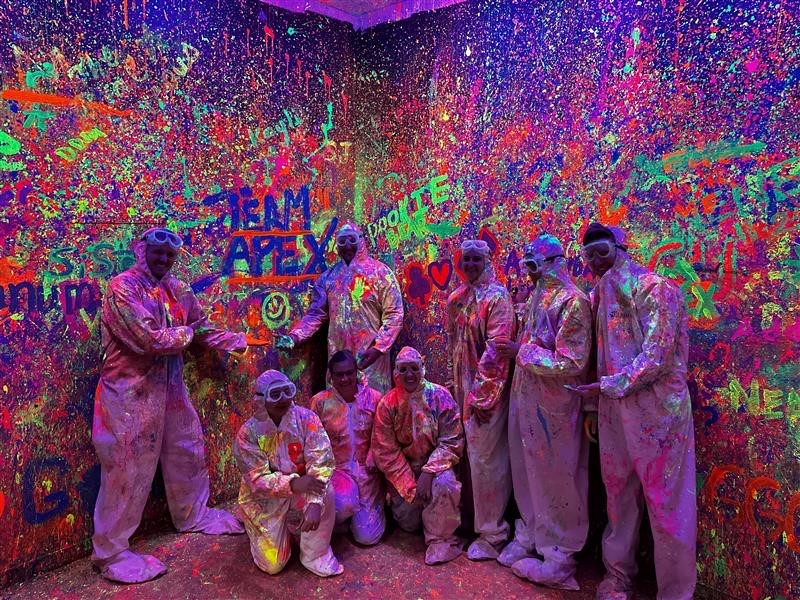
So far, my time in Apex’s budget office has been everything I hoped it would be. I began working in Apex in March, right as the budget for the next fiscal year was being drafted. Some unexpected absences in the office meant that I was quickly diving into various spreadsheets to track itemized spending for the fiscal year and highlight significant expenses for council reports. I’ve also been designated as the budget analyst for Apex’s Finance and Communications departments. These experiences have sharpened my Excel skills and emphasized the centrality of communication in budget work.
Apex’s budget office is a welcoming and supportive work environment. My coworkers here are happy to answer questions and support me and fellow UNC MPA intern Chris Bouzane in having a productive, hands-on Professional Work Experience. As I become more comfortable in this role and the proposed budget gets adopted, I hope to initiate a project that will combine my interests by exploring the impacts different land use patterns might have on Apex’s fiscal health. I am excited for the rest of the summer and hope I can take full advantage of it, as it is already passing by quickly!
This post was written by current student Wes Merritt.
 I’m Wes Merritt-an MPA candidate at the UNC Chapel Hill School of Government. I came to the University in the midst of a career change from the financial services world here in D.C. with hopes of learning more about how I can contribute as a public servant. The UNC MPA program felt like an obvious fit with their very practical and holistic course curriculum.
When I started my Masters back in early 2021, I had an idea of what I wanted to do- to work for either a non-profit or government agency that focused on substance abuse and recovery support services. I was tailoring all my class projects and papers around learning about that world but oddly enough fell in love with Economic Development after taking an elective with Joy Wilkins titled ‘Managing Economic Development’. I had no idea it was an actual profession but was really happy that it mirrored some of my sales/finance experience with the desire to enact more positive change in the public sector. It feels like a natural fit.
After doing some research on the profession I decided to pursue it for my PWE, and my professor Joy was kind enough to introduce me to her contact at the IEDC (International Economic Development Council) here in D.C., which actually writes the textbook for the class.
The internship is part-time, and my work is fully remote. I’m really excited about looking at different cities and counties through an Economic Development lens and getting a full picture of what Economic Developers do and how they add value to a local economy. Some of the projects I’ll be working on center around disaster relief and economic resiliency, along with traditional economic development ideas like corporate recruiting and human capital development at local universities.
This post was written by current student Rachel Werz.
———————————————————————————————–
 My name is Rachel Werz and I’m a North Carolinian, Returned Peace Corps Volunteer, and most recently a new mom! I’m in my third year of the online format of the MPA program. After getting my undergraduate degree in International Studies from UNC-Charlotte in 2009, I left the country to backpack through Southeast Asia. After 5 months of backpacking, I got a job teaching English in South Korea, and loved it so much I stayed for about 6 years. I then took my teaching skills to the U.S. Peace Corps, where I served as a teacher trainer in Indonesia. It was there that I found my passion for public service and sustainable development. I also met someone who became my mentor and introduced me to the field of public administration, suggesting it would be a good fit for me. She was right!
I applied for the UNC MPA program with my sights set on work at the federal level, in diplomacy or international development. However, as I’m sure has happened to many before me, the incredible MPA faculty’s expertise on local and state government has shifted my interests. As I enter my third and final year in the program, I am most interested in economic and community development. Through some of my volunteer work in Durham, I have gained experience in community development at the grassroots level. So, when looking for a PWE, I wanted to work for an organization that could offer professional experience in the same field. I reached out to Jamie McCall, a UNC MPA Alum, and the VP of Economic Development Policy at Carolina Small Business Development Fund (CSBDF). CSBDF provides financial and technical assistance, as well as policy research to small business owners in underserved communities across the state.
I’m now a research fellow for the Western Women’s Business Center (WWBC), which is a project of Carolina Small Business Development Fund. My first month has flown by! The research I am working on aims to identify gaps in the services provided by us and partner organizations to ensure we are meeting the needs of small business owners in Western North Carolina. Our goal is to strengthen the relationship that we have with small business owners and partner organizations by identifying our strengths and areas that need improvement. So far, I’ve really enjoyed the friendliness of everyone at CSBDF and working on the research project with a small team of fellow interns from UNC. I’m looking forward to the weeks ahead as I learn and grow in this internship!
This post was written by current student Delaney King.
———————————————————————————————-
As the summer has wrapped up and I have headed back to school, I have been thinking about everything I did this summer working for the Department of Environmental Quality (DEQ). The most notable project I worked on this summer is DEQ’s Use the Food NC food waste reduction initiative. So far, the organics recycling specialist and I have produced a residential food waste document, we are building a website for the campaign, we are creating a food waste recovery map through ArcGIS Online, and we are continuing to plan our stakeholder event, which will launch the campaign in October. As part of the strategic planning for the campaign, we met with Secretary Biser, and we talked with other southeastern states and national non-profits to discuss how their campaigns have unfolded. It has been such an amazing opportunity to be able to build a campaign from the ground up, and I could not be more excited to continue working with DEQ on this project during the school year. 
When I was not helping with the Use the Food NC campaign, I stayed very busy offering support to the rest of the Recycling and Materials Management Section (RMMS). I had a variety of tasks from compiling and analyzing data on local government television recycling programs, which helped project quota setting for the recycling fund that electronic manufactures must contribute to, to helping manage the updated NC Recycling Markets Directory. I am continuing to work on large projects like the Annual College and University Solid Waste and Recycling report and reviewing Local Government Annuals Solid Waste and Recycling reports with the rest of the RMMS team.
Every task I had has helped me better understand the recycling industry and improve skills – including using ArcGIS, Excel, Access, Drupal, etc. Still, my favorite part of the summer was our site visits to businesses, local governments, and non-profits across the state. Overall, I met with 14 different entities who had unique perspectives to share about the industry. These visits often turned into long days driving around the state, but I didn’t mind because I was learning, spending time with my phenomenal co-workers, and seeing North Carolina.
I cannot express how wonderful this PWE experience has been. I’ve learned a lot and met great people. I have certainly used the MPA lens to enhance my experience, understanding the makeup and culture of DEQ through organizational theory and ensuring the pillars of equity, efficiency, efficacy, and economy were applied in every project. I cannot wait to see where the MPA journey takes me next.
This post was written by current student Elisabeth Butler.
——————————————————————————————–
These past 10 weeks have gone by incredibly fast. My PWE is already coming to a close, but I feel like I have just found my stride in terms of figuring out my role in the organization and my relationship with my co-workers during these last final moments. There is most likely an abundance of knowledge that I have yet to tap into, but, even in such a short span of time, I have learned a lot by working for this organization.
From Zoom meetings to facilitation trainings, RACE for Equity has been very generous in terms of making sure I had plenty of work to keep me busy. I enjoyed the responsibility of serving as a Project Assistant for several projects, and I liked how the deliverables assigned to me were tailored toward my interests within the organization. For example, during the interview process with RACE for Equity, I mentioned that I was interested in community engagement and development. Due to my interest in community work, RACE for Equity worked with me to develop two deliverables that was related to my interests. One deliverable involved creating a condensed version of the Community Engagement Continuum (CEC), a training material developed by RACE for Equity, and another deliverable included researching best practices for Communities of Practice (CoP).
In addition to those two deliverables, RACE for Equity team members brought me on to help with a variety of other projects, such as creating a plan to transition from Microsoft Teams to Google Workspace and collecting documentation for clients. I appreciate how RACE for Equity tailored the PWE experience to my interests, but also exposed me to a variety of other tasks, topics, and projects that were unfamiliar to me but equally stimulating.
As I reflect on my experience working with RACE for Equity, I would say, overall, I enjoyed the work, but, even more, I enjoyed the people. I would like to use this space to say thank you to all of the RACE for Equity team members who welcomed me into the organization and helped me learn and grow as an individual. It really is a different experience to work alongside co-workers who are passionate about making a difference in the world. RACE for Equity was looking at the big picture, but also cared about the little things as well. For example, RACE for Equity would have a check-in for each meeting. The check-in wasn’t just some quick formality. You could tell that the team was genuinely interested in learning what was going on in the lives of others, and they were honest in terms of how they were truly feeling at that moment. It is that kind of openness that I appreciated. The more I learned about other team members, the more I wanted to work alongside them to do good work. Change takes time, but RACE for Equity has inspired me to remain hopeful and to do my part, to show up each day and chip away at the systemic boundaries that has held us all captive for too long.
This post was written by current student Jennifer Taylor-Monteagudo.
As a City of Richmond Mayor’s Fellow, I have had the opportunity to learn the how many of the UNC MPA courses correlate in a government entity. My internship in the Treasurer’s Office, an elected official, has enhanced my connection to various stakeholders. The unique opportunity has allowed me to work with city residents on the phone, in person, and via social media platforms. The ability to work with elected officials, residents, and city public servants has made knowledge of the organizational structure and effective communication key skills to successfully working with stakeholders at multiple levels within the city.
During the internship I have been afforded the opportunity to work on a variety of projects and efforts by the Treasurer’s Office including the Office of Financial Empowerment and Financial Wellness Wednesday. I have also had exposure to internal processes and how various departments interact to provide select services to residents of Richmond. The Freedom of Information Act (FOIA) requests process was of particular interest as governments in general are not known for efficient use of time and these requests are time sensitive. Understanding how the departments work together to obtain requested documents and remain in compliance with the required timeframe for a response has been a valuable lesson on developing and maintaining positive work relationships.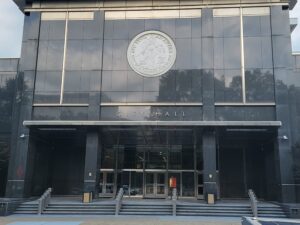
The primary focus of my internship is on assisting with the Office of Financial Empowerment through the Office of the City Treasurer. The Office of Financial Empowerment has a mission to “inspire, encourage, and pursue the high possibilities of potential in others through elimination of financial barriers by “Making Options and Resources Easily Accessible” for all. The office does this by incorporating financial coaching services, providing and promoting financial literacy throughout the city, and partnering with City Agencies to improve service to city residents facing poverty and COVID-19 related financial distress. This aspect of my internship has provided me with exposure on the intricacies of developing an idea to an action within the confines of the government. Aligning the needs of the community with the resources allocated to the department. I have been fortunate to see the partnering of multiple departments that have shared interests in the financial status of residents, combine their separate resources to make a larger impact to better the community.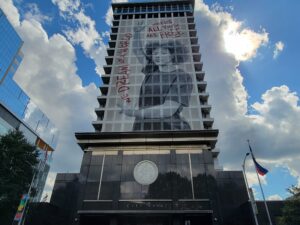
I was able to contribute towards the creation of financial tools that assist residents in learning to create and execute a budget. In addition I am able to create graphics that are aesthetically appealing to the public but also provide information and resources on how to become more financially empowered. These graphics are posted on social media regularly allowing an element of creativity while maintaining a consciousness of targeted audience. I was also able to use my teaching background to support the brainstorming on how to present and teach financial literacy to city residents. This opportunity allowed for my expertise to bring value and make the development thoughtful to the variety of adult learning styles within the city of Richmond.
So far in this internship experience as a City of Richmond Mayor’s Fellow, I have learned the importance of leadership and how it impacts outcomes for city employees and residents. As I progress through this fellowship, relationships has been a reoccurring theme. The building and development of strong relationships with all City Of Richmond stakeholders has been integral in the success of programs across multiple departments. Understanding the organizational structure and respecting that structure is important in acknowledging and building relationships and getting things accomplished. I am excited to continue to acquire knowledge and connections between the UNC MPA program and the reality of local public service.