This fall, the UNC MPA program welcomes 71 new students to the program. 31 are enrolled in the full-time on campus format and 40 are enrolled in the online format—which launched back in 2013 to accommodate working professionals across the country. Currently, the School of Government has 247 students enrolled across both formats of the MPA program.
Director of Admissions Cara Robinson says, “We are continuously thrilled with the level our new students are at. The public service mindset is palpable, and their contributions are already marked with leadership and commitment.”
UNC MPA enrolls students at all different points in their careers–from the 21-year-old recent graduate just starting their career to the 67-year-old retiree looking to reimagine their career in public service leadership/nonprofit work and give back to their communities. Several of our students are currently employed across the public sector and looking to gain leadership expertise and new skills. With interests in local, state, and federal government work to nonprofit organizations and even the private sector, students in the MPA program come packed with a variety of interest areas and goals. Approximately 65% of our new students come from different parts of North Carolina while the other 35% come from different parts of the country–as far west as Washington State and as far east as Washington, D.C. 19% of our new students are military affiliated.
We have interviewed four of our new students to find out more about them and why they’re pursuing the MPA degree. From environmental protection of sea turtles to public health collaborations between the private and public sectors, read more about our new students and where they’re going with UNC MPA.
Justin Guinta, oncampus format
Sarah Marzouk, oncampus format
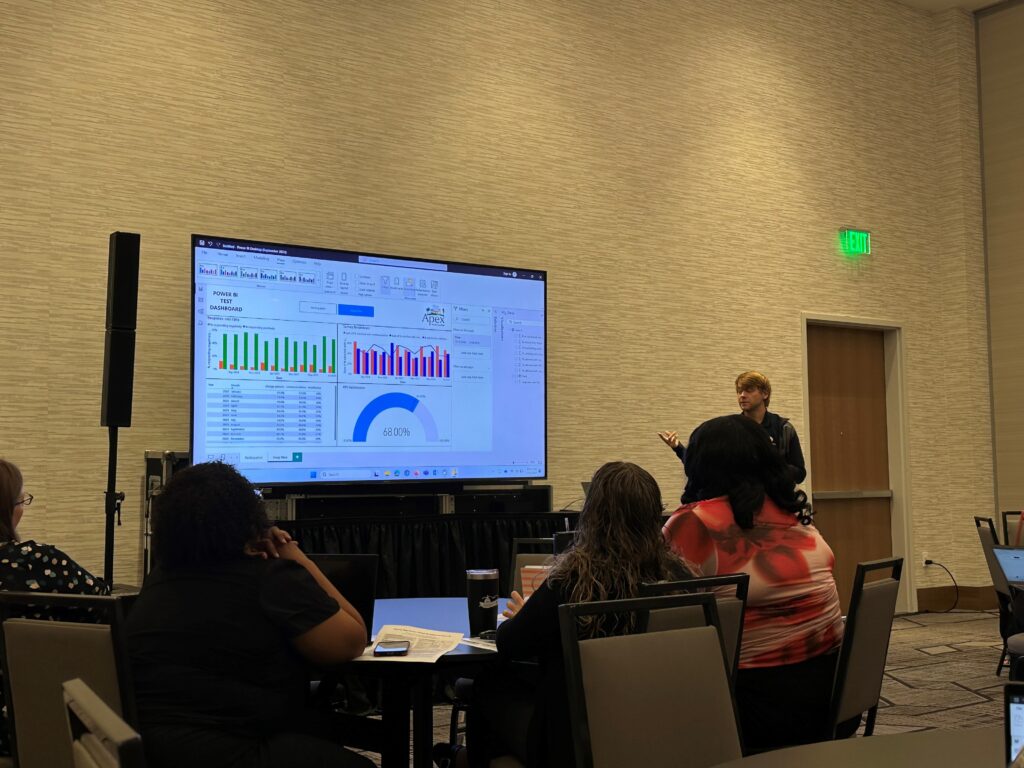
The North Carolina Benchmarking Project was established in 1995 to help municipalities compare their service and performance trends with other participating units. Each year, throughout August and September, partner municipalities submit performance and management data across eleven services to the University of North Carolina’s School of Government. The Benchmarking Project audits and uploads that data on a dashboard and invites participants to eleven performance strategy sessions in November to analyze data and discuss shared challenges and practices likely to resolve those challenges. The information from the strategy sessions and the dashboard is synthesized into annual reports.
Last year, the Benchmarking Project leveraged AI to manage report-development and data-auditing processes. The use of AI in these two tasks significantly reduced the hours spent on them, decreased the error rate, and strengthened the outcomes. This bulletin describes how the Benchmarking Project team adopted AI for that data auditing and report development. The team hopes that its experience will serve as an example for others thinking about leveraging AI to improve their processes.
Keegan Huynh, a special projects coordinator for the North Carolina Association of County Commissioners, and Christopher L. Cole II, a project coordinator for the North Carolina Benchmarking Project, co-authored this bulletin.
Download (pdf, 438.33 KB)
Join Director of Admissions, Cara Robinson as she discusses our broad-based leadership degree and how it can support you starting, advancing, or transitioning your career. Special attention will be paid to discussing what the MPA is, who it’s for, our career and program outcomes, and how this degree fits with a lot of different interest areas.
This will be held online via zoom and is open to anyone considering the online or oncampus UNC MPA.
By Cara Robinson
“Invest in the people around you, and you’ll build something far greater than any individual accomplishment.”
UNC MPA student Javier Limon follows these words as he embarks on his coming term as the elected President of the UNC Association of Student Government (ASG) and his ex-officio appointment for the coming year to the UNC Board of Governors. Javier found his way into student government first as the President of Eastern Carolina University’s student government, where he received his undergraduate major in political science. There, he developed a passion for service, leadership, and collaboration.
Enter Cameron Brown, also a current student in the UNC MPA program, who first met Limon at ECU, where he was also an undergraduate student pursuing his passion for government and student leadership. Brown served on the executive board of the student government as the Vice President of Media Outreach while Limon served as President.
This was only the beginning of their joint service. Since this time, they have alternated back and forth several times serving with one another. While Limon served as student body president at ECU, he hired Brown to serve as his director of local and state affairs. When Brown became president of ASG, he hired Limon to serve as Chief of Staff. Now this year, after Javier was elected President, he selected Cam to serve as his Vice President of Budget and Finance.
While the two admit that they are friends beyond just their interests in student government, they take their positions seriously and ensure that their respective assignments on each other’s staff have been earned and based on the merit and trust they have developed in each other over time.
“We definitely know each other’s strengths—and we play on those as we navigate our professional relationship” said Limon.
The two also simultaneously applied for the MPA program at UNC, were admitted, and decided to enroll in the program independently of one another. They both credit the program for providing the space where they can each grow as a leader—especially in the areas of communication, objectivity, and budget management while doing the work that fulfills their passion.
By pursuing the UNC MPA program and continuing to surround themselves around work and people who care about their communities, they have found themselves with a tangible skillset to practice as well as more experiences to practice these skills in.
Limon states: “I don’t worry too much about what will happen in the next 5 years. The MPA is allowing me to do the work I want to right now, and this degree is versatile and will go with me as I move forward in my career.”
Together, with their work in ASG and the UNC BOG, they have found themselves surrounded by other like-minded leaders who were put to the task of advocating for the more than 240,000 students they serve and helping to allocate resources across the 17 higher education institutions.
Through this work, they are harnessing what they have learned in the UNC MPA program to meet these goals. Whether it is strategic planning, reorganizing a department, or communicating out to a student body in a way they will understand, they have gained a tangible skillset to apply in their ASG and BOG work from UNC MPA.
“I’ve learned the importance ofbeing a leader who has morals and principles and isn’t afraid to put their foot down while also trying to be a leader who is collaborative and trying to build partnerships and coalitions so that everyone feels heard,” Brown reflected.
Looking forward to the future, neither knows exactly what is in store for their careers. Brown is drawn to local government and economic development work at the moment while Limon is currently interning with the federal government in the Minority Leaders Office in the United States House of Representatives. No matter where they end up, they both have their eyes on leaning into the challenges that exist in government work.
As Brown states: “Public service work truly matters, and if you understand what motivates you, nothing can keep you from wanting to do great work like this.’
Limon agrees.
“I can’t resign myself to complacency. Doing nothing is not an option for me. The best public servants understand that and understand that the challenges are the biggest opportunities for us to really make a difference.”
With the backing of the MPA program from UNC and their transferrable experiences across the BOG and ASG, the two’s path to joint service may come together again.
Sarah Dhunjishaw is originally from Colorado and received her undergraduate degree from Queens University. She is a 2nd year oncampus student interested in local government and is currently working on her Professional Work Experience with Wake County Budget Department.
—————————————————————————————
The North Carolina Local Government Budgeting Association awards two scholarships every year to attend their summer conference. This year, it was held July 9th-12th in Asheville, North Carolina for a weekend of learning, networking, and all things budgeting.
Sarah’s interest in budgeting developed after she discovered her interest in local government. Sarah was formerly a Lead for North Carolina Fellow who returned to the School of Government to obtain her MPA because ‘it felt like the right next step, and I always knew a Masters would help open career doors a bit wider for me’.
While Sarah discovered local government through the LFNC program, she has always had a public service mindset and had originally planned to go into nonprofit work. Through her local government experience, she began to learn the vastness of how local governments impact. As she explains, “Local government isn’t for a specific population. It serves everyone in a geographic area. So anyone within the geographic area, regardless of your socioeconomic status or specifics that a nonprofit might normally target, local government encapsulates all of those people.”
She began to see how the budgets told a story about where a community wants to go. “I want to be the person that’s working behind the scenes, telling the story, and helping people get the funding so they can implement the programs they want to do.” She has also enjoyed getting the chance to work with departments that serve the areas of education, public safety, social services, and other community services like parks and recreation and libraries.
First year students are required to take a budget and finance class, and Sarah used that class to help her figure out where she wanted to do her PWE. She chose to study Wake County’s local government budget as part of a class project which she said helped her land the Wake County Professional Work Experience this summer.
Over the next year, Sarah is gearing up to finish her MPA and hopes to continue her professional career in a budget office after she graduates.
As a graduate student that is interested in pursuing a career in local government budgeting, this experience at the NCLGBA conference was incredibly valuable to her. Through formal sessions at the conference, she was able to dig deeper into the current local government budget landscape in North Carolina and gained valuable takeaways on how to respond as a budgeter in this political atmosphere.
“The personal and professional development that I received from the sessions and networking events has helped prepare me for my future as a young professional in local government. I have left the NCLGBA conference inspired, motivated, and more knowledgeable about my chosen career path. I am so grateful to the NCLGBA for the scholarship and opportunity to attend such a transformational conference!”
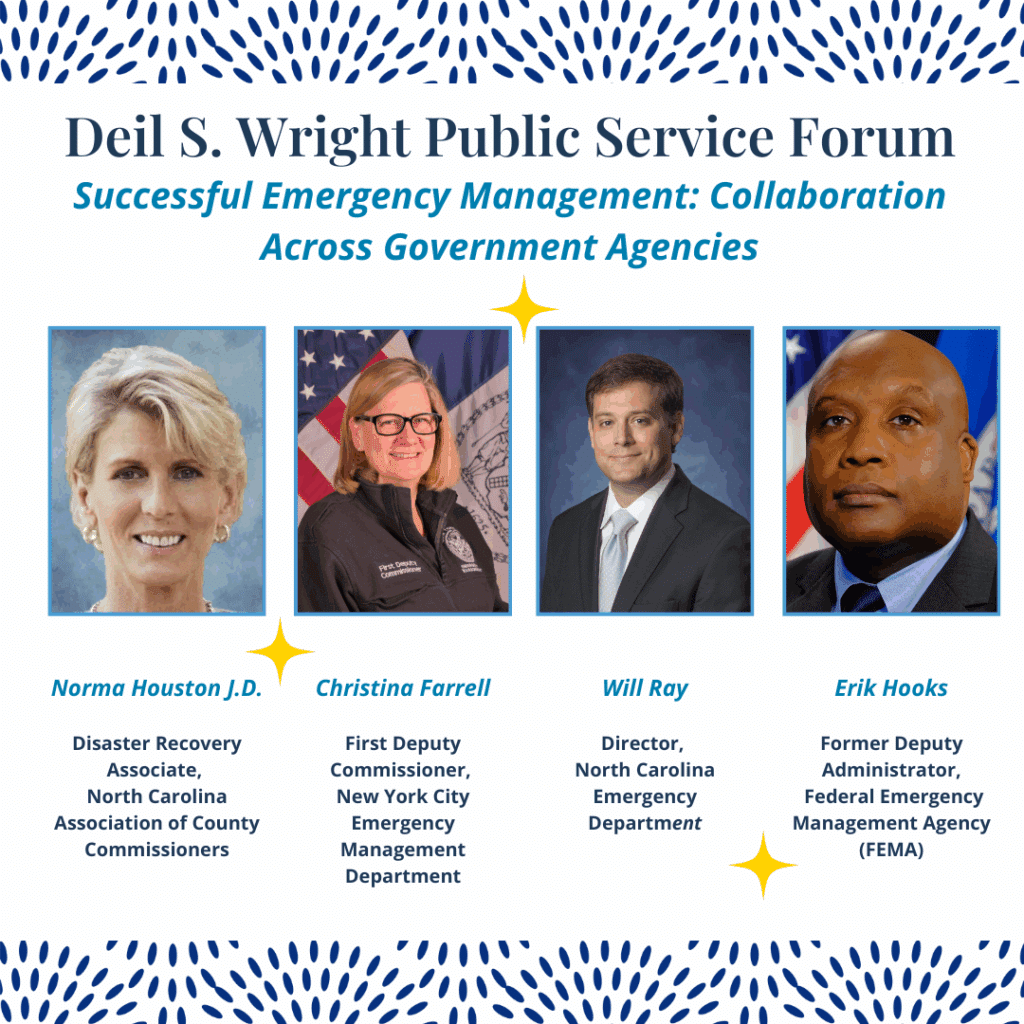
The theme of this year’s Deil S. Wright Public Service Forum is emergency management. Organized by School of Government faculty member Crista Cuccaro and offered In conjunction with the UNC MPA Immersion course on Emergency Management, this year’s Deil S. Wright Public Service Forum will feature an engaging discussion on the topic with experts and practitioners in the field.
The Deil S. Wright Public Service Forum will again be linked to the UNC MPA program’s Immersion course, this year on Emergency Management. The Forum will be a panel discussion moderated by Norma Houston that focuses on relationships and coordination between local, state, and federal governments for successful emergency management.
Speaking about emergency management from the local government perspective will be UNC MPA alumna Christina Farrell ’92, First Deputy Commissioner of the New York City Emergency Management; Will Ray, North Carolina Emergency Management Director; and Erik Hooks, former Deputy Administrator of the Federal Emergency Management Agency (FEMA).
In person registration for School of Government community members and #uncmpa program alumni. Reception to follow.
Virtual registration available for prospective students and those interested in emergency management.
This spring UNC MPA awarded diplomas to 41 graduates. We reached out to a few of them to find out what they’re up to this summer and post graduation. Each year the UNC MPA program graduates leaders ready for public service work. Our graduates are employed across all levels of government, non-profit organizations, and even the private sectors. Read about a few of them below.
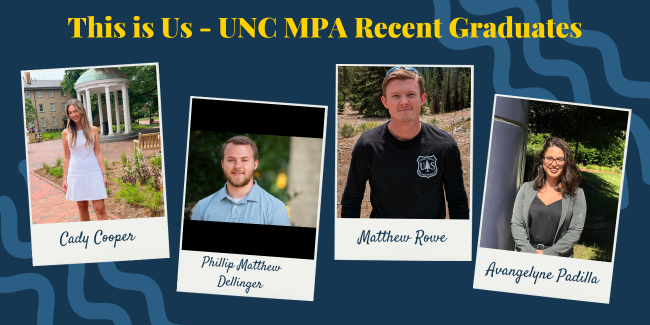
Cady Cooper – Legistlative Assistant, US Senate
Phillip Matthew Dellinger – Budget Analyst, City of Hickory
Matthew Rowe – Wildland Firefighter, US Forest Service
Avangelyne Padilla – Project Coordinator, Fountainworks
Former School of Government faculty member David Ammons, Albert Coates Professor Emeritus of Public Administration and Government, has authored a new publication. Published in May 2025, Improving Local Government Performance through Benchmarking describes the two types of benchmarking used by local governments—metrics benchmarking and best practice benchmarking—and cites examples and lessons learned across the nation and around the globe, including prominently lessons from the North Carolina Benchmarking Project.
Below, Ammons answers questions about the inspiration behind writing this book, expands on the complex nature of benchmarking for governments, and more.
What drove you to write this publication?
“I have been engaged in benchmarking projects throughout most of my career, including 25 years as a faculty advisor to the North Carolina Benchmarking Project. From experience and study, I have come to recognize and appreciate an array of considerations that shape the design of a benchmarking project and important issues that can affect its success. Writing this book was my opportunity to share what I have learned from my own research and experience, and from the research of other scholars in this field.”
What aspects of benchmarking are misunderstood by governments?
“Several aspects of benchmarking are not fully understood by many governments, but here I will mention two big ones. First, when done properly, benchmarking focuses on performance, not community or organizational characteristics or policies. A comparative inventory of characteristics or policies is not really benchmarking. Second, metrics benchmarking—the most common type of benchmarking in local government and the one most people think of—is not their only choice. Best practice benchmarking is an excellent choice as well.”
What can readers expect to learn from this publication?
“Many decisions are made, initially, in selecting a benchmarking type and, subsequently, in designing a benchmarking project without full consideration of the ramifications of those choices on the ultimate success of the project. Reading this book will help remove these blind spots.”
What are the two major types of benchmarking used by governments, and does one have advantages over the other?
“Most people are familiar with metrics benchmarking, the most common type in local government. Metrics benchmarking is a superb tool for diagnosing a department or program’s performance strengths and weaknesses. But if a manager or supervisor wants prescriptions for improving their unit’s performance, metrics benchmarking won’t do that. Best practice benchmarking will.”
by Katie Geith
New UNC School of Government faculty member Dylan Russell was recently recognized with three distinguished honors, which underscore his contributions to public service, higher education, and leadership at UNC-Chapel Hill and across North Carolina.
In March, Russell was inducted into the Order of the Golden Fleece, Carolina’s oldest honor society.
Founded in 1904, the Order fosters connections among students, faculty, and alumni and selects members based on extraordinary service to the university in scholarship, motivation, creativity, loyalty, and leadership in academic and extracurricular pursuits. Russell was nominated by Richard Stevens, former state senator, UNC MPA alumnus, and Chair Emeritus of the UNC Board of Trustees.
“I believe deeply in the promise of UNC-CH and what it means for North Carolina,” said Russell.“To be inducted into the Order of the Golden Fleece—and to join the ranks of giants from the School of Government like Mike Smith, John Sanders, Albert Coates, and Anita Brown-Graham—is a profound honor. Their commitment to service and leadership has shaped this state, and their example continues to inspire me every day. I’m humbled to carry that legacy forward and grateful to be part of a tradition that recognizes the power of public service to unite, elevate, and transform communities through Carolina’s work.”
Also this year, Russell received the Chancellor’s Award for Student Undergraduate Teaching, which honors outstanding faculty and teaching assistants who demonstrate excellence in instruction and impact on student learning. The Student Undergraduate Teaching Awards were established to recognize outstanding undergraduate instruction by both faculty and teaching assistants. Teaching nominations are reviewed based on demonstrated and consistent teaching excellence, success in positively affecting a broad spectrum of students both in and outside the classroom, and the creation of a dynamic learning environment.
Russell was recognized for his work teaching State and Local Government (PUBA 401), a service-learning course placing undergraduate students in nonprofits and local governments across the state. In the class, students work with community partners to create policy briefs that address issues faced by the community. The course also serves as a gateway to public service careers: six of Russell’s former students have gone on to enroll in the UNC MPA program, and many now serve in local government leadership roles across the state.
One nomination for the award read, “Russell embodies the highest standards of undergraduate teaching excellence. Through his commitment to experiential learning, mentorship, career preparation, and fostering an inclusive and dynamic classroom, he inspires students to pursue meaningful careers in public service.”
In May, Russell received an award from Engaging Local Government Leaders (ELGL) or top influencers in local government. ELGL is a national organization that celebrates innovation in local government. The award honors public sector professionals making a difference in their communities and who demonstrate joy, creativity, connection, dependability, and equity through their work and public activities. Russell was one of three honorees from UNC, alongside UNC MPA alumnus Pat Madej and PELA graduate Jonathan Russell.
About Dylan Russell
Dylan Russell joined the School as a teaching assistant professor in May 2025. He serves as the faculty co-lead of Lead for North Carolina at the UNC School of Government. Lead for North Carolina facilitates high-impact fellowships for recent graduates in local government throughout the state. Under Dylan’s leadership, Lead for NC has connected over 150 young leaders with fellowships and secured over 10 million in funding to support these initiatives. Dylan’s research explores strategies for workforce development, talent retention, and institutional capacity in government organizations.
Meg is a current student from Naperville, Illinois, a suburb of Chicago. She graduated from Butler University in Indianapolis where she studied Political Science, Geography & Global Societies, and Peace & Conflict Studies.
————————————————————————————————————–
Q1: Why are you pursuing an MPA?
I chose to pursue an MPA because I have always been drawn to high-impact work that shapes communities in meaningful ways. Through my experiences working with local governments, nonprofits, public-private organizations, and private companies in college, I recognized the value of an MPA in bridging my work in these sectors and equipping me with the skills to advance my career. I chose UNC because of its welcoming community, the School of Government’s strong reputation both in North Carolina and nationally, and the opportunity to be part of a growing region with dynamic economic development and local government opportunities.
Q2: Can you share a bit about your background before joining the program?
Before joining the program, I gained diverse internship experiences. My first internship was with Project C.U.R.E., an international nonprofit, where I researched potential funders and drafted letters of intent to secure grant funding for medical supplies distributed to Ukraine and other countries in need. I also interned with the City of Indianapolis, where I worked across multiple departments, including the Office of Education and Innovation, the Department of Metropolitan Development, and the Office of Public Health and Safety. I then joined VOX Global, a public affairs agency, where I supported over 25 accounts, ranging from national banks to local nonprofits. Finally, I interned with Downtown Indianapolis Inc., where I contributed to the establishment of an Economic Enhancement District and led a survey assessing the impact of events on local businesses.
Q3: What has been the most valuable course or experience in the MPA program thus far?
One of the most valuable experiences in my MPA journey has been the opportunity to apply public administration theories to real-world challenges. Whether it’s engaging stakeholders or developing strategic policies, the program has provided a hands-on understanding of how effective leadership and collaboration drive meaningful change. A key part of this has been the variety of guest speakers in different classes, who bring class concepts to life and demonstrate their real-world applications in the public administration field. This exposure to practitioners has deepened my understanding of course material and reinforced the program’s practical focus. Building on this, the most impactful experience so far has been attending the NCEDA Career Trek. This event featured panels of incredibly knowledgeable professionals who provided context for much of what I learned in my Managing Economic Development elective in the fall. I also formed connections with professionals who have become mentors and have supported me with class projects. These relationships have been invaluable in shaping my academic and professional journey.
Q4: How do you balance the program with other commitments?
I have found it manageable to balance coursework with personal and professional opportunities. The class schedule provides ample time to fully commit to assignments while allowing flexibility for networking, attending conferences, and maintaining a healthy work-life balance—whether that means going to UNC sporting events, spending time with friends, or working out. This flexibility has enabled me to attend the ICMA National Conference, where I connected with local government professionals from across the country, and the NCEDA Career Trek, which deepened my understanding of economic development in North Carolina.
Q5: What is your favorite part about the program?
My favorite part of being in the UNC MPA community is, broadly, the people. This program has given me meaningful friendships that I truly cherish and know will be long-lasting. We are also fortunate to learn from professors who are both experts in their fields and dedicated mentors, making classes engaging, fun, and impactful. Additionally, the strong alumni network has been an invaluable part of my experience—alumni have been incredibly generous, offering guidance, support, and insights that have enriched my journey in the program.
Q6: What is your advice to someone considering the program or graduate school in general?
To anyone considering this program, my advice is to stay open-minded and curious. You may enter with a clear career path in mind, but some of the most valuable growth comes from exploring new perspectives and opportunities. Build relationships with peers, professors, and alumni, and take advantage of the opportunities that come your way. Staying flexible will help you make the most of this experience and uncover new passions along the way. I also thought two years would feel long, but now that I’m nearly halfway through, I can say it flies by—so embrace every moment and enjoy the journey!
Q7: What will you be doing this summer?
I’m spending my summer with the Granville County Manager’s Office, where I’m supporting County Administration in coordinating agency activities and aligning departmental work with the vision of the Board of Commissioners. I’m also assisting individual departments—especially economic development and budget—through various research projects, data analysis, content creation, and more. The role allows me to contribute to ongoing initiatives while gaining a deeper understanding of how county government operates across departments.
Outside of school, I enjoy barre and other fitness classes, exploring new coffee shops and restaurants, attending sporting events, listening to The Mel Robbins Podcast, and traveling whenever I can.