Food Insecurity Isn’t Really About Food: A Recap of the Deil S. Wright Public Service Forum
Originally posted by Cat Schmidt, School of Government, November 5, 2026
Food insecurity experts gathered at the 2026 Deil S. Wright Public Service Forum delivered a clear message: hunger in the state of North Carolina is both a systemic and money-related problem, especially in a relatively wealthy state—and country—with plenty of food.
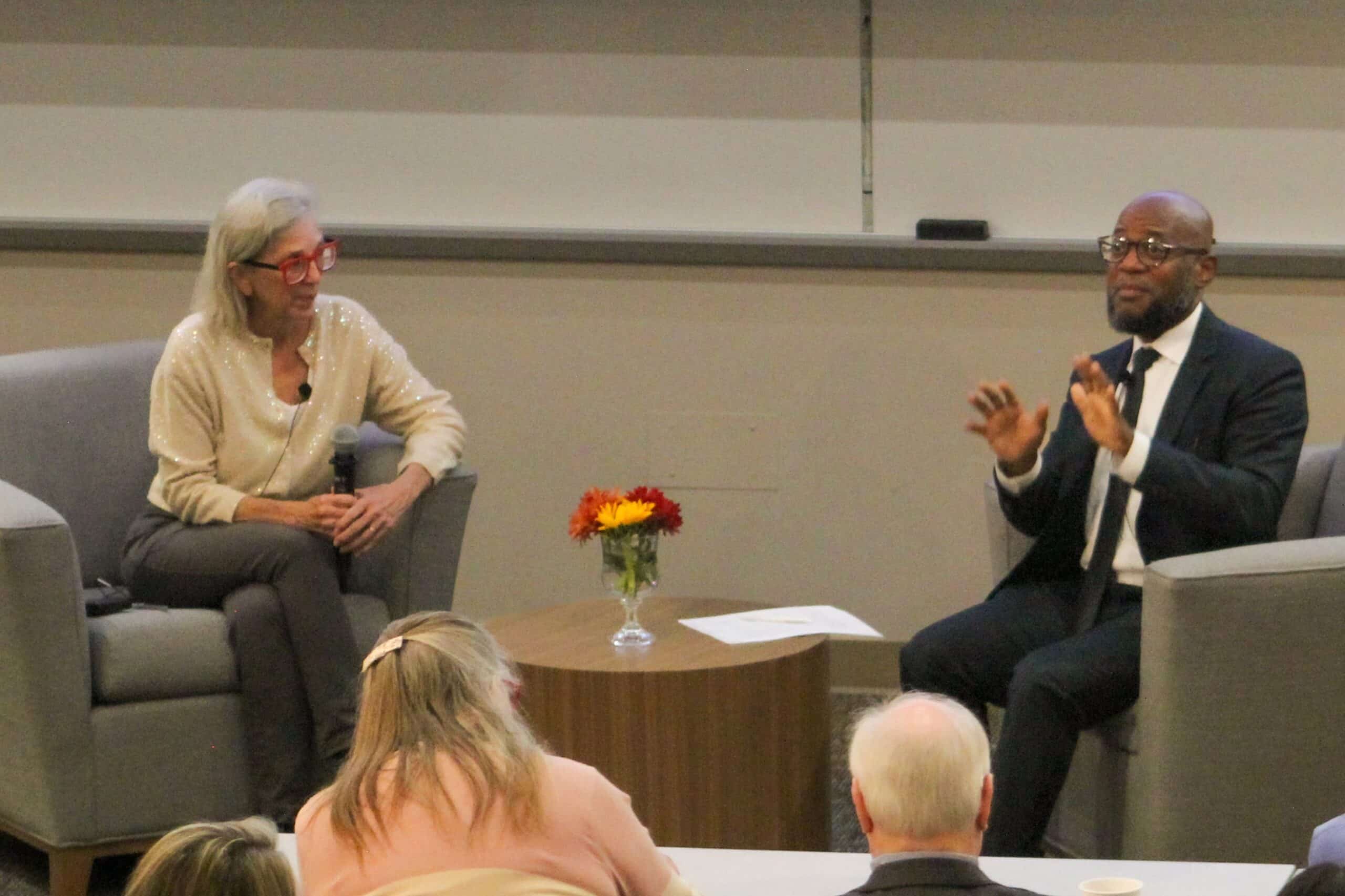
“It ain’t about food,” said Norbert Wilson, director of the World Food Policy Center at Duke University, at the October 9 event at the UNC School of Government. The country has plenty of food; the barrier for most families is whether they can afford it, affirmed UNC School of Government faculty member and co-panelist Maureen Berner. They were joined by Carlos Morales, a recent UNC Master of Public Administration graduate now serving as food security program manager for Wake Count. Morales introduced the speakers and their discussion on the national and local food insecurity landscape as well as major issues pertaining to funding and food distribution systems.
An affordability problem
According to Wilson, about 13.8 percent of U.S. households are food insecure. He described the trade-offs that people makethat lead to that number: whether to buymedicine, pay forschool activities, pay fortransportation, orbuygroceries. Households headed by women with children face even higher rates—30 to 35 percent—of food insecurity. Food prices that jumped during the COVID-19 pandemic in 2020–2021 have not come back down, and acut in an employee’s workhourscan erase a paycheck’s value even when wages hold steady. There is also a new blind spot on the landscape: the federal government stopped collecting national food insecurity data annually; the last available numbers are from 2024.
SNAP is the backbone
The Supplemental Nutrition Assistance Program, or SNAP, costs the federal government about $100 billion per year, and 12 to 13 percent of U.S. households participate. Berner pointed to the immense scale of federal support: “For every one meal that comes from a charitable source, nine meals are provided by SNAP.” Wilson noted that SNAP typically covers about three weeks of the monthly needs in eligible households, and many families fill the gap at a local food pantry. Berner added that North Carolina’s charitable food providers have grown from more than 2,000 to about 3,700, a sign that the system is under strain.
A public administration problem
Wilson and Berner proposed that the strain is often administrative. Berner described a U.S. state in which SNAP recertification notices arrived in mailboxes after benefits had already been cut off because offices lacked the capacity to process paperwork on time. Wilson discussed the systemic factors that contribute to growing food scarcity. People juggling jobs, childcare, and tight budgets struggle with complicated systems. “If you create a whole slew of administrative challenges for someone to re-up their SNAP benefits,” he said, “you’re asking for them to not succeed.” Programs must also make sure the right people receive benefits, he acknowledged, so the challenge is to strike the right balance of accountability.
Stigma and dignity
Berner said one of the biggest issues preventing people from asking for assistance is stigma. She described back-to-school nights at her children’s grade school and high school. At the grade school, staff walked families through available benefits and helped them complete paperwork on site. At the high school, a counselor spent about two minutes saying students could come to her office for forms. One setting was inclusive. The other was stigmatizing.
The case for universal meals
Berner acknowledged that hungerwon’t be solved entirely, but said some policies manage it better than others.A leading example was the Community Eligibility Provision, which lets high-poverty schools serve free meals to every student. When most students already qualify, Berner said, feeding everyone saves paperwork, money, and stigma. The objection that “some families could pay” doesn’t hold, she argued, when the discussion turns to efficiency and results. Wilson noted that Durham County has adopted community eligibility and covers part of the cost itself. Research suggests students tend to do better in school when meals are available, though he said findings vary.
The charge to future leaders
Berner closed by urging students to rethink systems from the beginning, before they think about cost. Wilson added that future leaders can help others see hunger as a shared challenge. “We can begin to understand that this is a communal challenge,” he said, “when we think we can never have a difficult time, it’s easy to distance ourselves from those who are struggling. You never know when you are going to be in need.”