This fall, the UNC MPA program welcomes 71 new students to the program. 31 are enrolled in the full-time on campus format and 40 are enrolled in the online format—which launched back in 2013 to accommodate working professionals across the country. Currently, the School of Government has 247 students enrolled across both formats of the MPA program.
Director of Admissions Cara Robinson says, “We are continuously thrilled with the level our new students are at. The public service mindset is palpable, and their contributions are already marked with leadership and commitment.”
UNC MPA enrolls students at all different points in their careers–from the 21-year-old recent graduate just starting their career to the 67-year-old retiree looking to reimagine their career in public service leadership/nonprofit work and give back to their communities. Several of our students are currently employed across the public sector and looking to gain leadership expertise and new skills. With interests in local, state, and federal government work to nonprofit organizations and even the private sector, students in the MPA program come packed with a variety of interest areas and goals. Approximately 65% of our new students come from different parts of North Carolina while the other 35% come from different parts of the country–as far west as Washington State and as far east as Washington, D.C. 19% of our new students are military affiliated.
We have interviewed four of our new students to find out more about them and why they’re pursuing the MPA degree. From environmental protection of sea turtles to public health collaborations between the private and public sectors, read more about our new students and where they’re going with UNC MPA.
Justin Guinta, oncampus format
Sarah Marzouk, oncampus format
By Cara Robinson
“Invest in the people around you, and you’ll build something far greater than any individual accomplishment.”
UNC MPA student Javier Limon follows these words as he embarks on his coming term as the elected President of the UNC Association of Student Government (ASG) and his ex-officio appointment for the coming year to the UNC Board of Governors. Javier found his way into student government first as the President of Eastern Carolina University’s student government, where he received his undergraduate major in political science. There, he developed a passion for service, leadership, and collaboration.
Enter Cameron Brown, also a current student in the UNC MPA program, who first met Limon at ECU, where he was also an undergraduate student pursuing his passion for government and student leadership. Brown served on the executive board of the student government as the Vice President of Media Outreach while Limon served as President.
This was only the beginning of their joint service. Since this time, they have alternated back and forth several times serving with one another. While Limon served as student body president at ECU, he hired Brown to serve as his director of local and state affairs. When Brown became president of ASG, he hired Limon to serve as Chief of Staff. Now this year, after Javier was elected President, he selected Cam to serve as his Vice President of Budget and Finance.
While the two admit that they are friends beyond just their interests in student government, they take their positions seriously and ensure that their respective assignments on each other’s staff have been earned and based on the merit and trust they have developed in each other over time.
“We definitely know each other’s strengths—and we play on those as we navigate our professional relationship” said Limon.
The two also simultaneously applied for the MPA program at UNC, were admitted, and decided to enroll in the program independently of one another. They both credit the program for providing the space where they can each grow as a leader—especially in the areas of communication, objectivity, and budget management while doing the work that fulfills their passion.
By pursuing the UNC MPA program and continuing to surround themselves around work and people who care about their communities, they have found themselves with a tangible skillset to practice as well as more experiences to practice these skills in.
Limon states: “I don’t worry too much about what will happen in the next 5 years. The MPA is allowing me to do the work I want to right now, and this degree is versatile and will go with me as I move forward in my career.”
Together, with their work in ASG and the UNC BOG, they have found themselves surrounded by other like-minded leaders who were put to the task of advocating for the more than 240,000 students they serve and helping to allocate resources across the 17 higher education institutions.
Through this work, they are harnessing what they have learned in the UNC MPA program to meet these goals. Whether it is strategic planning, reorganizing a department, or communicating out to a student body in a way they will understand, they have gained a tangible skillset to apply in their ASG and BOG work from UNC MPA.
“I’ve learned the importance ofbeing a leader who has morals and principles and isn’t afraid to put their foot down while also trying to be a leader who is collaborative and trying to build partnerships and coalitions so that everyone feels heard,” Brown reflected.
Looking forward to the future, neither knows exactly what is in store for their careers. Brown is drawn to local government and economic development work at the moment while Limon is currently interning with the federal government in the Minority Leaders Office in the United States House of Representatives. No matter where they end up, they both have their eyes on leaning into the challenges that exist in government work.
As Brown states: “Public service work truly matters, and if you understand what motivates you, nothing can keep you from wanting to do great work like this.’
Limon agrees.
“I can’t resign myself to complacency. Doing nothing is not an option for me. The best public servants understand that and understand that the challenges are the biggest opportunities for us to really make a difference.”
With the backing of the MPA program from UNC and their transferrable experiences across the BOG and ASG, the two’s path to joint service may come together again.
By Andy Bradshaw
The School of Government congratulates faculty members Whitney Afonso and Kimberly Nelson, who were honored with receipt of the 2025 Best Book Award from the American Society for Public Administration’s (ASPA) Section on Public Administration Research.
Their joint publication—Municipal Corruption: From Policies to People—is the most comprehensive exploration of corruption in U.S. municipal governments written to date. Exploring the 30-year period from 1990 to 2020 and including all U.S. municipalities with populations of 10,000 people or more, Afonso and Nelson used both quantitative research and case study analysis to answer the question of why some municipalities fall victim to corrupt acts, while others do not. It tells the stories of a number of communities that suffered through public corruption; the book investigates factors that contribute to a greater risk of corruption in municipalities and identifies steps to prevent corruption in communities―including strengthening resident interest and involvement in local affairs, offsetting the decline in local journalism, and reinforcing scrutiny by state governments.
The publication begins with two sets of quantitative analyses that expand on work published in two peer-reviewed articles. From these studies, the book concludes that the council-manager form of government is associated with lower risk of a municipal corruption conviction. The remainder of the book dives deeper into the variables associated with corruption risk through its examination of corruption cases in U.S. municipalities and provides recommendations for methods for reducing corruption risk.
The collection of the data was challenging, according to Nelson.
“The process of collecting the data on municipal corruption was time-consuming; we spent more than two years collecting it,” she said. “We first used data from the U.S. Department of Justice’s Public Integrity Section and supplemented it with a keyword search in newspaper databases to find corruption convictions through the courts system.”
“We are really proud of this book. It couples rigorous analysis with an incredibly important topic—public corruption,” said Afonso. “We analyze what governments may be particularly susceptible to corruption from bad actors and what are actual policies and levers that governments can pull to lower the likelihood of corruption. We hope that this book will be a resource to academics, state and local governments, and those interested in hindering corruption.”
ASPA’s SPAR welcomed nominations for books on public administration published in 2024 and 2023. The Best Book Award evaluates criteria such as outstanding accomplishment of the research objectives, high-quality writing, and potential to constitute a lasting contribution to public administration literature.
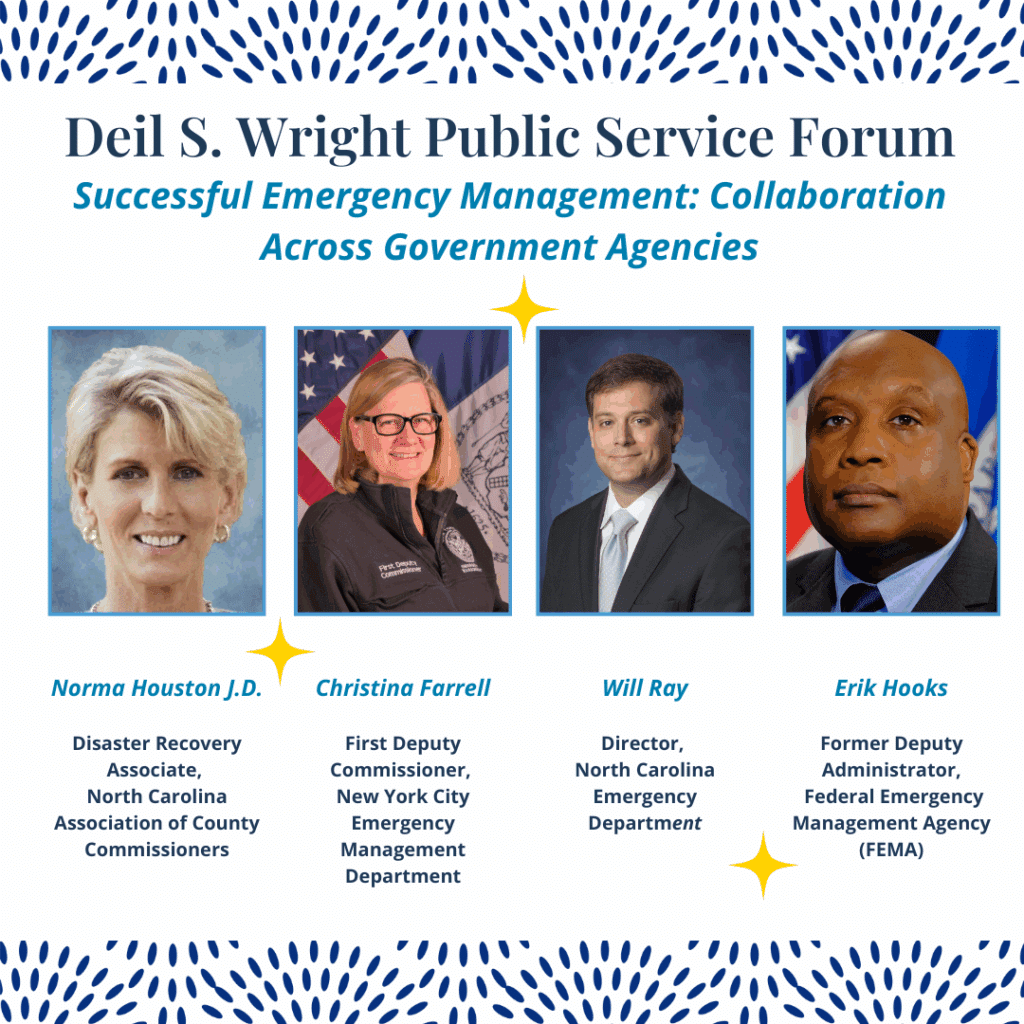
The theme of this year’s Deil S. Wright Public Service Forum is emergency management. Organized by School of Government faculty member Crista Cuccaro and offered In conjunction with the UNC MPA Immersion course on Emergency Management, this year’s Deil S. Wright Public Service Forum will feature an engaging discussion on the topic with experts and practitioners in the field.
The Deil S. Wright Public Service Forum will again be linked to the UNC MPA program’s Immersion course, this year on Emergency Management. The Forum will be a panel discussion moderated by Norma Houston that focuses on relationships and coordination between local, state, and federal governments for successful emergency management.
Speaking about emergency management from the local government perspective will be UNC MPA alumna Christina Farrell ’92, First Deputy Commissioner of the New York City Emergency Management; Will Ray, North Carolina Emergency Management Director; and Erik Hooks, former Deputy Administrator of the Federal Emergency Management Agency (FEMA).
In person registration for School of Government community members and #uncmpa program alumni. Reception to follow.
Virtual registration available for prospective students and those interested in emergency management.
This spring UNC MPA awarded diplomas to 41 graduates. We reached out to a few of them to find out what they’re up to this summer and post graduation. Each year the UNC MPA program graduates leaders ready for public service work. Our graduates are employed across all levels of government, non-profit organizations, and even the private sectors. Read about a few of them below.
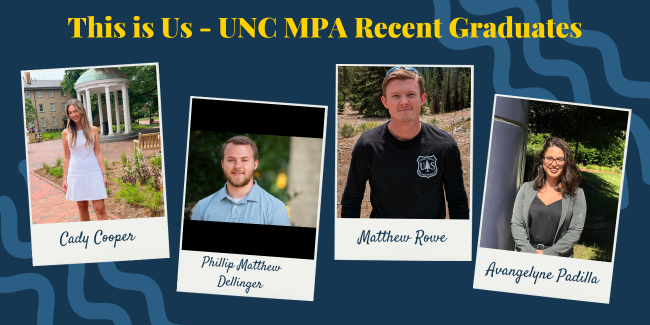
Cady Cooper – Legistlative Assistant, US Senate
Phillip Matthew Dellinger – Budget Analyst, City of Hickory
Matthew Rowe – Wildland Firefighter, US Forest Service
Avangelyne Padilla – Project Coordinator, Fountainworks
Former School of Government faculty member David Ammons, Albert Coates Professor Emeritus of Public Administration and Government, has authored a new publication. Published in May 2025, Improving Local Government Performance through Benchmarking describes the two types of benchmarking used by local governments—metrics benchmarking and best practice benchmarking—and cites examples and lessons learned across the nation and around the globe, including prominently lessons from the North Carolina Benchmarking Project.
Below, Ammons answers questions about the inspiration behind writing this book, expands on the complex nature of benchmarking for governments, and more.
What drove you to write this publication?
“I have been engaged in benchmarking projects throughout most of my career, including 25 years as a faculty advisor to the North Carolina Benchmarking Project. From experience and study, I have come to recognize and appreciate an array of considerations that shape the design of a benchmarking project and important issues that can affect its success. Writing this book was my opportunity to share what I have learned from my own research and experience, and from the research of other scholars in this field.”
What aspects of benchmarking are misunderstood by governments?
“Several aspects of benchmarking are not fully understood by many governments, but here I will mention two big ones. First, when done properly, benchmarking focuses on performance, not community or organizational characteristics or policies. A comparative inventory of characteristics or policies is not really benchmarking. Second, metrics benchmarking—the most common type of benchmarking in local government and the one most people think of—is not their only choice. Best practice benchmarking is an excellent choice as well.”
What can readers expect to learn from this publication?
“Many decisions are made, initially, in selecting a benchmarking type and, subsequently, in designing a benchmarking project without full consideration of the ramifications of those choices on the ultimate success of the project. Reading this book will help remove these blind spots.”
What are the two major types of benchmarking used by governments, and does one have advantages over the other?
“Most people are familiar with metrics benchmarking, the most common type in local government. Metrics benchmarking is a superb tool for diagnosing a department or program’s performance strengths and weaknesses. But if a manager or supervisor wants prescriptions for improving their unit’s performance, metrics benchmarking won’t do that. Best practice benchmarking will.”
By Sonja Matanovic
On a Monday morning in March, School of Government faculty member Kara Millonzi prepares to lead more than 50 public officials in a weekly ritual she calls “Finance Office Hours.” It is a time she and her colleagues set aside each week for the last five years—or sometimes every other week—to pull together the public finance officers working in local and state governments across North Carolina via Zoom.
These are not your average office hours for a university professor. For starters, everyone participating is a professional, most of them have their camera off, and while Millonzi’s tone is upbeat and helpful and her information is designed to be accessible to students, the content is dense and loaded with acronyms, technical language, and slides. And it comes on the heels of North Carolina’s worst and most expensive natural disaster: Hurricane Helene.
County and municipal government employees were on the front lines of this disaster and continue to work the front lines of the recovery effort. A December 2024 report by the Office of State Budget and Management noted that two keys to success in storm recovery are “1) quickly mobilizing significant, flexible capital and (2) proactively investing in local capacity and expertise to support post-disaster efforts.”
It’s the “significant, flexible capital” part that Millonzi has been working on lately after nearly two decades advising North Carolina’s local governments in the areas of public budgeting and finance. In addition to helping them shore up their financial reserves, access state and local disaster recovery funds, and balance their budgets, Millonzi provides a safe place for peer learning and for encouragement during a difficult time in their profession, when local government balance sheets might not look great because of cash flow issues due to Hurricane Helene.
“Kara’s deep expertise, combined with her approachability, made office hours a lifeline that local governments relied upon week after week,” said Lacy Pate, director of disaster recovery and grant assistance with the North Carolina Association of County Commissioners.
History of Office Hours
Finance office hours took off as a resource for North Carolina’s public officials during the COVID-19 pandemic in 2020, bringing finance professionals together with School of Government faculty to navigate urgent legal and practical challenges related to the pandemic.
Millonzi was an early adopter of Zoom at the School and used the tool to set up meetings when it was impossible to gather in person. Participants discussed executive orders, such as those that temporarily stopped collections from residential public utility customers, and financial tools like small business revolving loan funds, to help local governments support their communities during a tough time.
By 2022, finance office hours had evolved into a platform for understanding the American Rescue Plan Act’s Coronavirus State and Local Fiscal Recovery Funds (SLFRF), a program authorized by former President Joe Biden and designed to deliver $350 billion to state, territorial, local, and Tribal governments across the country to support recovery from the pandemic.
As with most federal funding, compliance standards were plentiful, and many North Carolina local governments—especially those with few staff members or simply inexperienced in working with federal funding—were in need but intimidated by the challenges they faced in accessing the funds. “Because SLFRF is administered by the U.S. Treasury, which is not a typical grant-making agency, local governments needed expert guidance, as well as peer collaboration and support,” said Pate.
Five years later, Millonzi and her colleagues are still leading weekly virtual office hours to provide up-to-date guidance on complex and shifting federal funding requirements, particularly on those related to disaster relief. The office hours help School faculty and others better understand issues facing different communities, and the information shared on these calls helps Millonzi be responsive to public officials and target the resources she’s creating for local governments.
“Office Hours provides the unique opportunity to overlay the federal guidelines with state statutes and requirements,” said Maria Standfest, a grants/project analyst with New Hanover County’s finance department. “What we learned early on is that just because Treasury says we can use SLFRF funds in certain ways, it doesn’t mean that it’s allowable in the state of North Carolina.”
“It’s hard to believe that we have had access to such a wealth of information at no cost,” added Standfest.
Then Came Hurricane Helene
In September 2024, Millonzi and her colleagues quickly adapted office hours to address Helene-related concerns, demonstrating the value of real-time problem-solving and peer support.
“Our region is rural and many of the local governments we serve are small,” said Cory Osborne, director of economic recovery and resilience with High Country Council of Governments, serving Alleghany, Ashe, Avery, Mitchell, Watauga, Wilkes, and Yancey counties, all of which are located within Hurricane Helene’s FEMA-designated disaster areas.
“The calls after Helene have been a great resource for us,” said Osborne. “Most of my department’s work shifted after the storm to helping local governments with the FEMA Public Assistance (PA) Program. Navigating the PA program is challenging and complex. Alongside complying with FEMA regulations, local governments also must follow procurement requirements and statutory requirements on how they handle funding,” he added.
Osborne noted that the recurring support and knowledge the School offers has helped High Country Council of Governments navigate financial complexities. Knowing experts are easily reachable has been a comfort to employees and the communities they serve.
Finance officers from coastal North Carolina communities—many of whom have previous experience with hurricane recovery—also provided comfort, insights, and tips on these calls for their peers in western communities that were devastated by Hurricane Helene and in urgent need of federal funding.
Over time, the focus of finance office hours has broadened to cover general local government law and finance. While each government has its own challenges unique to their circumstances, they face many issues in common—an urgent need for a pipeline of employees trained in public finance, lack of training in navigating federal funding requirements, and not enough staff.
“Within the calls themselves, there’s wonderful information shared between local governments,” said Standfest. “Many times, questions are shared with the group and other units are able to answer them or offer their own experiences. They share obstacles they’ve encountered, solutions they’ve found, and recommendations for others.”
Office hours also foster collaboration between School faculty, local governments, and organizations such as the North Carolina Association of County Commissioners, regional Councils of Government, and state agencies. It has been particularly helpful to address hot topics and emerging issues.
“There is always a dedicated group of officials seeking guidance and sharing insights to support one another. It has become a community, where we all learn from each other, share with each other, and sometimes commiserate with each other,” said Millonzi. “I look forward to it every week.”
Published April 8, 2025
by Katie Geith
New UNC School of Government faculty member Dylan Russell was recently recognized with three distinguished honors, which underscore his contributions to public service, higher education, and leadership at UNC-Chapel Hill and across North Carolina.
In March, Russell was inducted into the Order of the Golden Fleece, Carolina’s oldest honor society.
Founded in 1904, the Order fosters connections among students, faculty, and alumni and selects members based on extraordinary service to the university in scholarship, motivation, creativity, loyalty, and leadership in academic and extracurricular pursuits. Russell was nominated by Richard Stevens, former state senator, UNC MPA alumnus, and Chair Emeritus of the UNC Board of Trustees.
“I believe deeply in the promise of UNC-CH and what it means for North Carolina,” said Russell.“To be inducted into the Order of the Golden Fleece—and to join the ranks of giants from the School of Government like Mike Smith, John Sanders, Albert Coates, and Anita Brown-Graham—is a profound honor. Their commitment to service and leadership has shaped this state, and their example continues to inspire me every day. I’m humbled to carry that legacy forward and grateful to be part of a tradition that recognizes the power of public service to unite, elevate, and transform communities through Carolina’s work.”
Also this year, Russell received the Chancellor’s Award for Student Undergraduate Teaching, which honors outstanding faculty and teaching assistants who demonstrate excellence in instruction and impact on student learning. The Student Undergraduate Teaching Awards were established to recognize outstanding undergraduate instruction by both faculty and teaching assistants. Teaching nominations are reviewed based on demonstrated and consistent teaching excellence, success in positively affecting a broad spectrum of students both in and outside the classroom, and the creation of a dynamic learning environment.
Russell was recognized for his work teaching State and Local Government (PUBA 401), a service-learning course placing undergraduate students in nonprofits and local governments across the state. In the class, students work with community partners to create policy briefs that address issues faced by the community. The course also serves as a gateway to public service careers: six of Russell’s former students have gone on to enroll in the UNC MPA program, and many now serve in local government leadership roles across the state.
One nomination for the award read, “Russell embodies the highest standards of undergraduate teaching excellence. Through his commitment to experiential learning, mentorship, career preparation, and fostering an inclusive and dynamic classroom, he inspires students to pursue meaningful careers in public service.”
In May, Russell received an award from Engaging Local Government Leaders (ELGL) or top influencers in local government. ELGL is a national organization that celebrates innovation in local government. The award honors public sector professionals making a difference in their communities and who demonstrate joy, creativity, connection, dependability, and equity through their work and public activities. Russell was one of three honorees from UNC, alongside UNC MPA alumnus Pat Madej and PELA graduate Jonathan Russell.
About Dylan Russell
Dylan Russell joined the School as a teaching assistant professor in May 2025. He serves as the faculty co-lead of Lead for North Carolina at the UNC School of Government. Lead for North Carolina facilitates high-impact fellowships for recent graduates in local government throughout the state. Under Dylan’s leadership, Lead for NC has connected over 150 young leaders with fellowships and secured over 10 million in funding to support these initiatives. Dylan’s research explores strategies for workforce development, talent retention, and institutional capacity in government organizations.
Graduates of the UNC Master of Public Administration program gathered Saturday, December 14 to celebrate commencement. Friends, faculty, and staff convened to honor the 16 graduates as they begin the next phase of their public service journey.
During the ceremony, graduates were hooded and pinned by UNC MPA Director Willow Jacobson. In her remarks, she congratulated her former students on their successful completion of the program and urged them to remain passionate in their pursuit of public service—a hallmark trait of UNC MPA graduates.
“Congratulations to the Master of Public Administration graduates. Your dedication, hard work, and passion for public service have brought you to this momentous achievement,” she said. “The mission of the MPA program is ‘to prepare public service leaders and create useable knowledge that improves governance.’ The leaders graduating today join an amazing alumni base that continues to have meaningful and impactful change in the organization and communities in which they work. We are incredibly proud of you and excited to see the remarkable contributions you will make in the future.”
Congratulations to our December graduates:
Alexander Canan
Mariya Carrier
Stacey Conner
Natalee Dally
Laura Gomez-Nichols
Olivia Jessup
Jenna Kubiak
Malasia McClendon
Madeline Milligan
Cristina Ortiz
Thomas Persico
Mary Propst
Fernando Santillan
William Summer
Krystal Wallick
Audrey Wheeler
Read about two of our recent graduates – Madeline Milligan and William Summer as they tell us about their post-graduation plans and how the MPA has helped shape their career.
After a summer state government internship and a waste audit, Brianna Beadle is back to studying public administration.
By Joshua McCormack, University Communications, Wednesday, September 11th, 2024

For Brianna Beadle, public service has long been part of her identity.
After receiving a bachelor’s degree in criminal justice from Florida Atlantic University, Beadle took time off to work in the Florida Student Power Network, where she serves as part of their advisory board. She is now in Chapel Hill pursuing a dual master’s degree in public administration with the UNC School of Government and the city and regional planning department in the College of Arts and Sciences.
Despite the intense workload a dual master’s degree entails, Beadle was not interested in having a quiet summer. Instead, she spent most of her time interning with the North Carolina Department of Environmental Quality.
“It was my job to research composting across the state and find how recycling can feed into our economy,” Beadle said. “I would talk to individuals at composting recycling facilities and ask how they believed they were affecting their community.”
Beadle says it was eye-opening to see how political machinations and cynicism among state residents influenced either a negative or indifferent response to composting in many communities. Certain projects, however, reminded her of the positive impact composting can have.
“I worked on a waste audit at the department’s building where we implemented a composting bin and then analyzed a day’s worth of trash,” Beadle explained. “We found out that after implementing the bin, we had reduced waste in the building over the summer.”
Beadle was also inspired by the hard work of the department’s team. When she wasn’t gathering statistics or doing field site visits to different North Carolina counties, she sat in on meetings listening to individuals talk about making a difference.
“One of the most impactful things was when I got to do a Q&A with the DEQ secretary Elizabeth Biser,” Beadle said. “Just having someone at her level say, ‘Hey, there’s a future for you on this career path’ was really important.”
Biser and others have provided inspiration for what Beadle can do after her time at Carolina. She has developed a passion for state government and believes this summer’s experience with the DEQ gave her an understanding of how environmentalism is feasible in our economy.
“I learned so much about how our climate and economy are intertwined,” Beadle said. “I’d love to have a role in telling people how renewable energy is feasible and how to embrace composting. I want to let people know there’s a way to slowly transition to better resources for our environment.”
This year at Carolina, Beadle is looking forward to expanding her knowledge in housing and community development. She will also serve as president of the MPA’s Diversity Committee, in which she hopes to showcase different career opportunities in public administration that celebrate diversity.
No matter what Beadle accomplishes during her time here at Carolina or in the years that follow, there can be no doubt that her work will be for the betterment of the community.